Lost Hiking? Stay Put, Call 999, Use STOP Method
What to Do If You Get Lost While Hiking in Ireland
It happens to experienced walkers. A junction that looked obvious on the map, a moment of distraction, and a low cloud that rolled in and swallowed the landmarks you were navigating by— and suddenly the path underfoot doesn't look familiar. Getting lost while hiking in Ireland is more common than people admit, and knowing the right lost hiking safety tips can turn an unsettling moment into a manageable situation. What matters is what you do next.
Here's a calm, practical guide to getting yourself back on track— and how to make sure it doesn't happen in the first place.
Lost Hiking Safety Tips: The First Rule Is Stop
start="0">The worst thing you can do when you realise you're lost on a hiking trail is to just keep walking. Moving further into unfamiliar terrain in the hope that something will look familiar is how a manageable situation becomes a serious one.
The moment you're unsure of your position, stop where you are. Find a dry spot to stand or sit, take a breath, and give yourself a few minutes to think clearly before doing anything else.
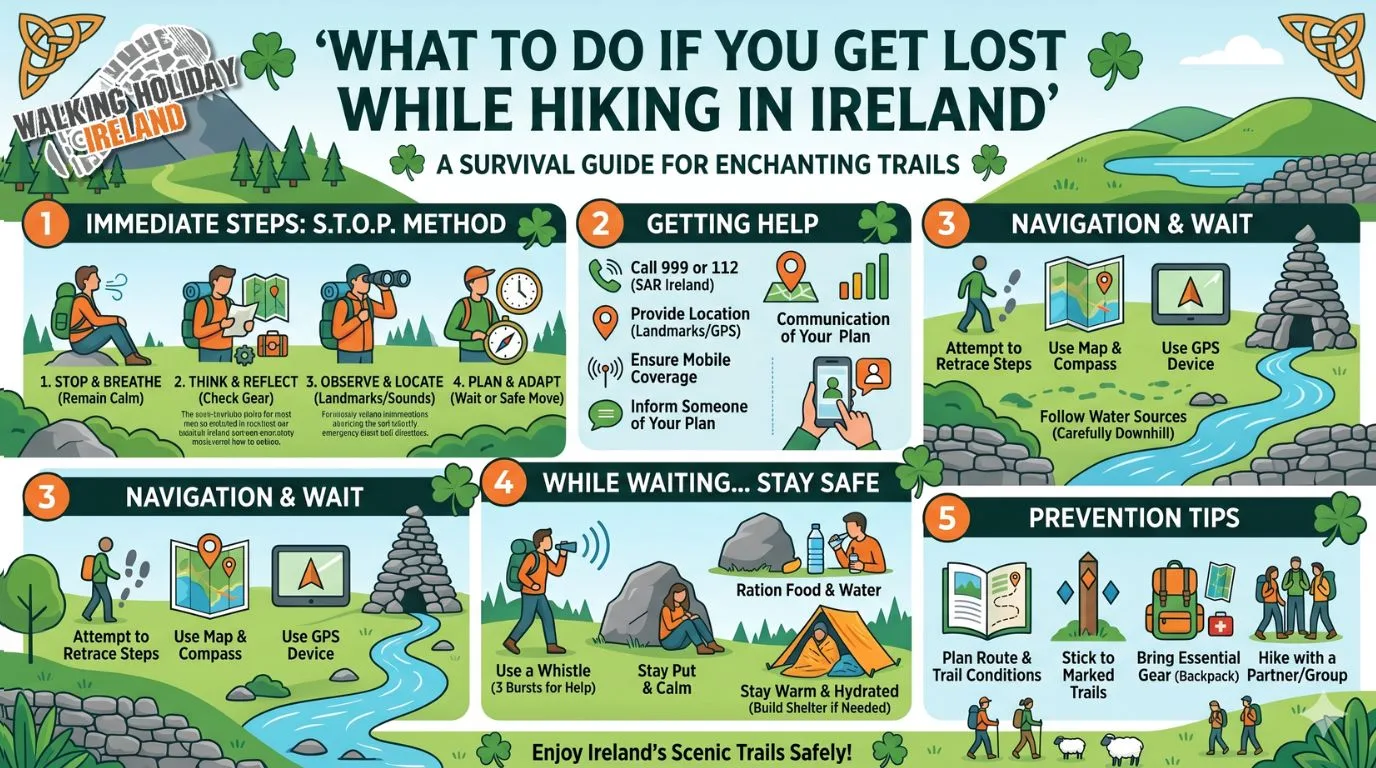
This is the basis of the STOP method hiking — a simple framework used by mountain rescue teams and outdoor educators worldwide as part of essential hiking emergency procedures Ireland.
S — Stop: Don't move until you've assessed the situation
T — Think: When did you last know exactly where you were? What did you pass? How long ago?
O — Observe: Look around. Any landmarks? A ridgeline, a river, a valley? Which direction is the sun or wind coming from?
P — Plan: Decide on your next move based on what you know — don't guess and walk
Most walkers who follow this method find that the situation is far more manageable than it first felt. The trail is usually not far away.
Mountain Rescue Ireland: Call for Help and Know What to Say
If you can't determine your position or if you're injured, knowing what to do when lost on trail means calling for help immediately. In Ireland, the emergency number for Mountain Rescue is 999 or 112—ask for it and stay on the line.
The most helpful things you can tell someone over the phone are:
Your last known location — the last waymarker, road, village, or recognisable feature you passed
Your GPS coordinates, if your phone has a navigation app open (Google Maps, Maps.ie, or a hiking app like ViewRanger will show these)
The time you set out and roughly how long you've been walking
How many people are in your group and whether anyone is injured
What you're wearing — rescuers scanning from a distance or helicopter need to know what to look for
If your signal is weak, send a text message rather than attempting a voice call — texts often get through in areas where calls won't. If you have no signal at all, move to higher ground before trying again.
Before your walk: always share your route and expected return time with someone back at your accommodation. If you don't check in on time, they can raise the alarm.
Stay Put and Signal Your Position
Once you've made contact with someone who knows you're lost — whether that's a family member, your accommodation host, or emergency services — stay where you are. Rescuers will be working from your last known location. If you wander, you make their job significantly harder.
Make yourself easy to find:
Stay near a visible landmark — a large rock, a stream junction, or a ridgeline. These give rescuers a reference point
Use your emergency whistle at regular intervals. Three short blasts is the international distress signal. An emergency whistle for hiking carries much further than a shout and uses far less energy
If you have a bright-coloured jacket or a foil emergency blanket, make it visible. Lay it open on the ground if there's any chance of an aerial search
Keep your phone battery conserved — turn off apps you don't need and lower your screen brightness
Retracing Your Steps
If you've stopped, thought it through, and you're confident about where you went wrong, retracing your route is often the safest option—a key part of trail navigation Ireland. Go back the way you came, don't try to shortcut across terrain you don't know.
Look for the signs your passing left: boot prints in soft ground, bent grass, and disturbed mud. On an Irish mountain in wet weather, these are often visible for a good while after you've passed.
Check your map and try to match what you can see around you to what's on paper. Look for rivers, ridges, valleys, and peaks— these are the landmarks that appear on OS maps and offer essential navigation tips hikers can rely on to pin down your rough position even without GPS. If you have a compass, orient your map to north before you try to read it.
One useful rule in Irish terrain: water flows downhill to civilisation. Following a stream or river downhill will almost always bring you to a road, a valley, or a farm. It's not a navigation technique for normal hiking, but if you're genuinely disoriented, it's a reliable way back toward people.
Hiking Safety Ireland: What to Do While You Wait
If you're waiting for help to arrive, your priority is to stay warm, dry and hydrated. The Irish uplands can be cold at any time of year, and a still walker loses heat faster than a moving one.
Put on every layer you're carrying — now is not the time to save them
Get out of the wind if you can — behind a rock or in a sheltered dip in the ground makes a real difference
Eat and drink something, but ration your supplies — you don't know how long you'll be waiting
A foil survival blanket weighs almost nothing and fits in a jacket pocket — it reflects body heat back toward you and can make a significant difference on an exposed hillside
Keep moving your hands and feet gently if the cold sets in — small movements help maintain circulation
Try to stay calm. Panic raises your heart rate, clouds your thinking, and burns energy. The vast majority of lost walkers in Ireland are found within a few hours. Mountain rescue Ireland teams possess extensive experience, superior equipment, and remarkable speed.
How to Avoid Getting Lost Hiking in the First Place
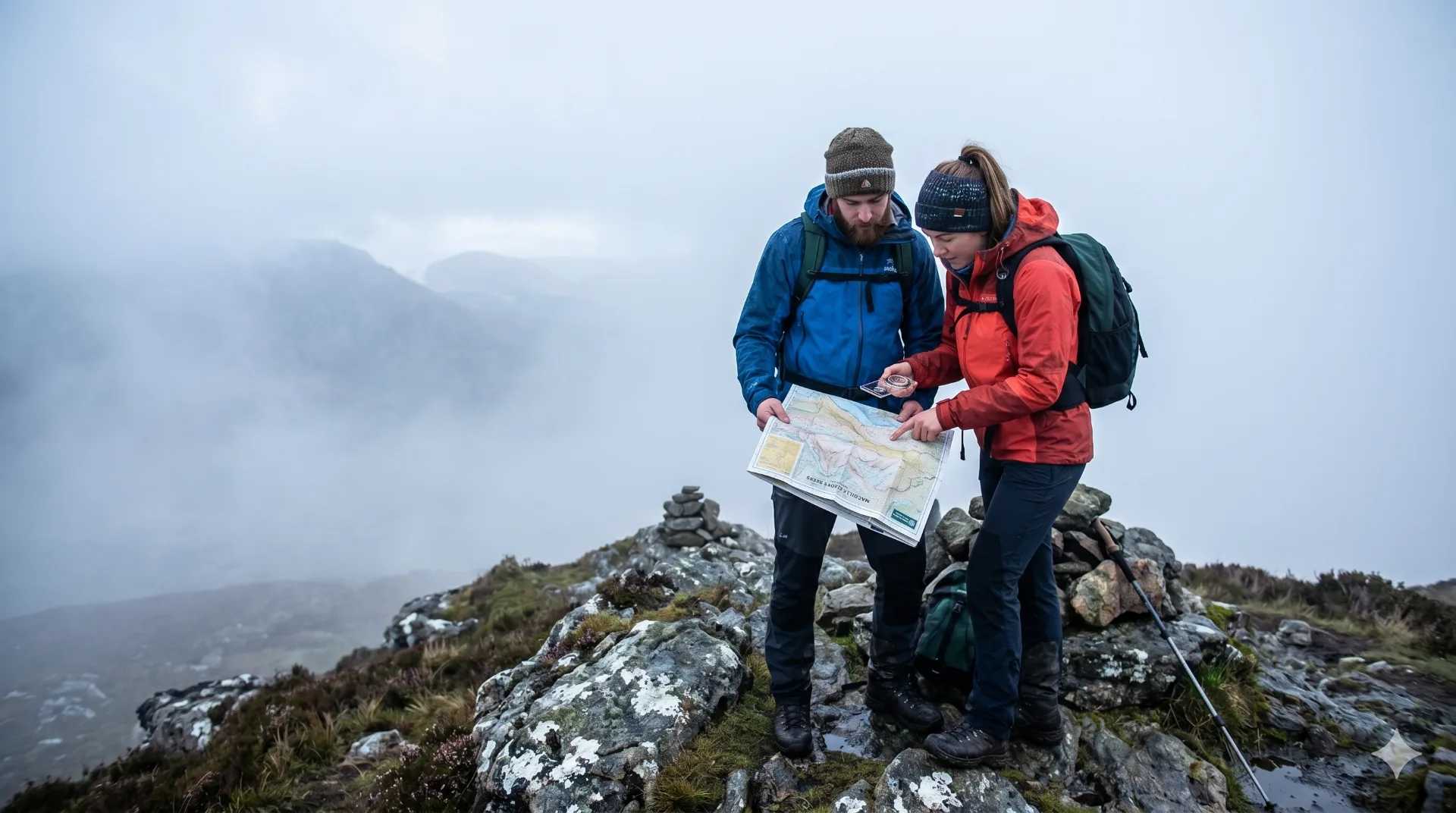
The good news is that most of the scenarios above are entirely preventable. A little preparation before you set out removes most of the risk.
1) Know your route before you walk it.
Study the map the evening before, not on the path. Note the key junctions, the major landmarks, and the waymarker posts for your stage. On Ireland's long-distance trails — the Kerry Way, the Wicklow Way, and the Dingle Way — waymarker posts are your primary navigation tool. If you haven't seen one in a while, stop and check your position.
2) Download your GPS track before you leave.
Mobile signal is unreliable in upland areas across Ireland. An offline GPS track on your phone works without signal and shows you exactly where you are on the route at all times—essential for trail navigation in Ireland. Apps like OS Maps, ViewRanger, or Komoot all support offline use.
3) Carry a paper map and compass.
Phones run out of battery, screens wash out in rain, and apps crash. My safety tips for hiking include carrying a waterproof map case and a basic compass as cheap insurance.
4) Tell someone where you're going.
Your accommodation host, a friend, or a family member—anyone who knows your planned route and your expected return time. This one step ensures that if something goes wrong, the alarm raises quickly rather than hours later.
5) Don't push on in deteriorating conditions.
If visibility drops, the weather changes, and you are no longer sure of your position, hiking safety tips dictate stopping before things get difficult, not after. There is no shame in turning back. Ireland's trails will still be there tomorrow.
Ready to Walk Ireland's Trails with Confidence?
The truth is that walking in Ireland is safe, well-managed, and deeply rewarding. The scenarios in this guide are the exception, not the rule — and with the right preparation, they're almost entirely avoidable.
All WHI walkers receive a detailed pre-departure pack with stage maps, GPS files, route notes, and a 24/7 support line for every day on the trail. We've walked these routes in every condition Ireland can produce, and we're happy to share everything we know before you set out.
Browse our self-guided walking tours or get in touch to start planning your Irish walking adventure.
Frequently asked questions
Should I retrace my steps if I get lost on a hiking trail?
Yes, if you clearly remember the last point where you were confident of your location. Retracing your steps is often the safest option, especially if visibility is poor or you've only been walking for a short time since that point. However, if you're unsure how far back that was or conditions have worsened, it's better to stay put and reassess using the STOP method.
When should I call mountain rescue in Ireland?
Call 999 or 112 and ask for mountain rescue if you're injured, unable to move safely, completely disoriented in poor weather, or darkness is approaching and you have no shelter or light. It's not embarrassing to call for help—rescue teams would much rather come to you early than search for you later. Always call before your phone battery runs out.
What's the most common reason hikers get lost in Ireland?
Poor visibility due to sudden weather changes is the leading cause. Mist and low cloud can roll in quickly on Irish mountains, obscuring the path and landmarks within minutes. Other common reasons include overestimating navigation skills, not carrying a map and compass, and continuing to walk when unsure rather than stopping to check position.
Do I need a GPS device for walking in Ireland or is a phone enough?
A smartphone with downloaded offline maps will work for most marked trails in good conditions, but it shouldn't be your only navigation tool. Phones lose battery quickly in cold or wet weather, and signal can be patchy in remote areas. Carrying a paper map, compass, and ideally a dedicated GPS device gives you backup options if technology fails.
What should I do if I'm lost and it's getting dark?
Stop moving immediately and find the safest spot nearby—ideally sheltered from wind with some visibility of the surrounding area. Put on all your warm layers, use your emergency whistle or torch to signal your position, and call for help if you have signal. Trying to navigate unfamiliar terrain in darkness significantly increases the risk of injury.
Continue exploring
Getting prepared before you walk makes all the difference when things don't go to plan.
- How to read a map and compass
- Best GPS devices for hiking in Ireland
- What to pack for Irish hiking weather