Walking the Beara Way: A Complete Guide to Ireland's Wildest Peninsula Loop
There are corners of Ireland where the country still feels properly remote — where you can walk for half a morning without passing a house, where the road bends around a sea cliff and a Kerry mountain shows itself across the bay, where the loudest sound is the wind off the Atlantic. The Beara Peninsula is the best of these places, and the Beara Way is the trail that takes you all the way around it.
Part of our complete guide to Ireland's National Waymarked Ways — a trail-by-trail rundown of every long-distance walk in Ireland.
The Beara Way is a 196-kilometre circular waymarked trail that loops the Beara Peninsula in south-west Ireland, straddling the border of County Cork and County Kerry. It rises and falls between sea level and the lower slopes of the Caha and Slieve Miskish mountains, passing through small fishing villages, copper-mining country, ancient stone circles, and some of the wildest coastline left in western Europe. Between us, the Walking Holiday Ireland team has walked every section of it many times. This guide is what we'd want to know before our first crossing.
Most walkers we send out spend six or seven days on the trail. Some take eight to slow down, others tackle a five-day section. All of them, almost without exception, come back saying the same thing: Beara is the one that surprised them.
What Walking the Beara Way Is Actually Like
Beara is quieter than the Kerry Way and the Dingle Way, its better-known neighbours. You will share the trail with sheep and the occasional fellow walker, not with coach tours. Whole afternoons go by where the only people you meet are at the pub in the next village. After a week of this, the rest of the country starts to feel rather busy.
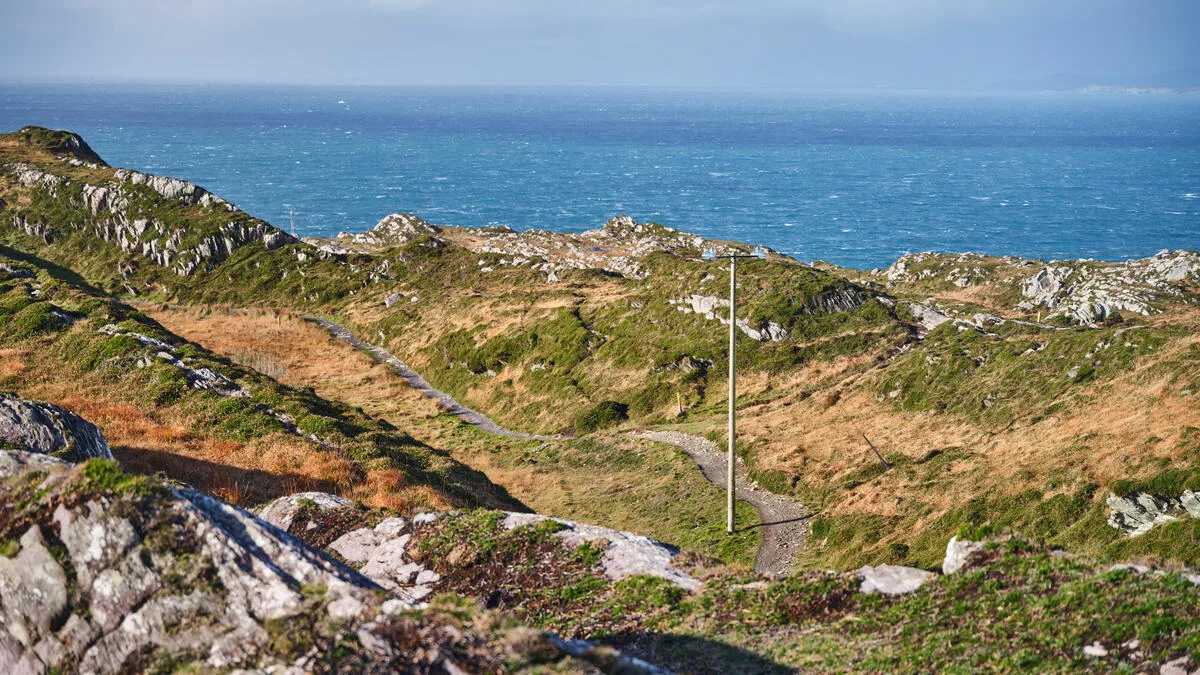
The walking itself is mixed and honest. You'll cross open moorland with views down to the sea, follow grassy boreens between dry-stone walls, climb steadily over low mountain passes, drop into hidden valleys, and skirt the coast on cliff paths and old smugglers' tracks. Underfoot, expect tarmac, gravel, grass, mud, peat, and the occasional stretch of bog. Decent waterproof boots are not optional. Neither is a waterproof jacket — the Atlantic makes the weather here, and an hour of sun followed by an hour of rain followed by an hour of sun is a normal Beara afternoon.
Daily distances on a comfortable itinerary are 18 to 24 kilometres with 300 to 600 metres of climbing. There are no long high-mountain crossings of the kind you find on the Kerry Way, but the cumulative effort over six or seven days is real. If you walk a few hours at the weekend back home, you'll be fine. If you don't walk much, build up in the months before you come — your knees will be grateful on the descents into Allihies and Glengarriff.
The Beara Way Route, Day by Day
Here is how we break the trail down on our flagship 7-day self-guided itinerary. It's the way we'd walk it ourselves — sensible daily distances, the right villages overnight, and the best of the coast saved for the days when your legs are warmed up.
Day 1: Arrive in Kenmare
Kenmare is a Georgian market town with three short main streets, two excellent bookshops, and as many good restaurants as you would expect somewhere four times its size. We start your trip here. You arrive, settle into your B&B, walk the heritage trail around the town, find dinner, and get an early night.
Day 2: Kenmare to Tuosist (about 18 km)
You leave Kenmare on quiet lanes, climb gently into the foothills of the Caha Mountains, and pick up the line of the trail proper. The walking is easy by Beara standards — green roads, old droving tracks, glimpses of Kenmare Bay below. A first taste of why you came.
Day 3: Tuosist to Lauragh (about 19 km)
One of the loveliest days on the trail. You cross open moorland with the long blue line of the bay always somewhere over your shoulder, drop into the broad valley above Glanmore Lake, and finish in Lauragh — a tiny village on the Kerry side of the peninsula with a pub that takes its time. The Healy Pass climbs up the slope opposite. You will recognise it from postcards.
Day 4: Lauragh to Allihies (about 22 km)
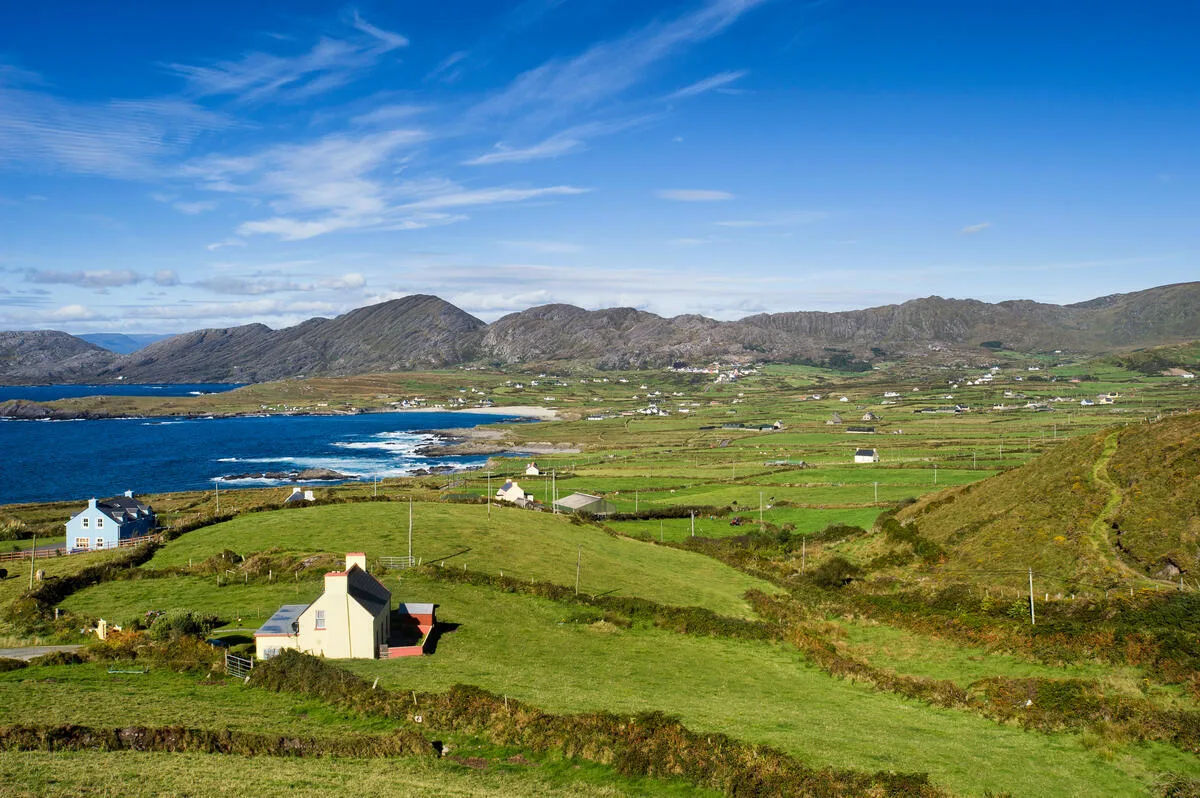
The trail crosses back into Cork and works its way along the northern coast through Ardgroom and Eyeries, two of the prettiest villages anywhere on the Wild Atlantic Way. Eyeries is famous for its painted houses — pinks, blues, ochres, lime greens — and is the kind of place where lunch takes longer than you planned. The day finishes with a long descent into Allihies, the old copper-mining village above a wide, sandy beach.
Day 5: Allihies to Castletownbere (about 19 km)
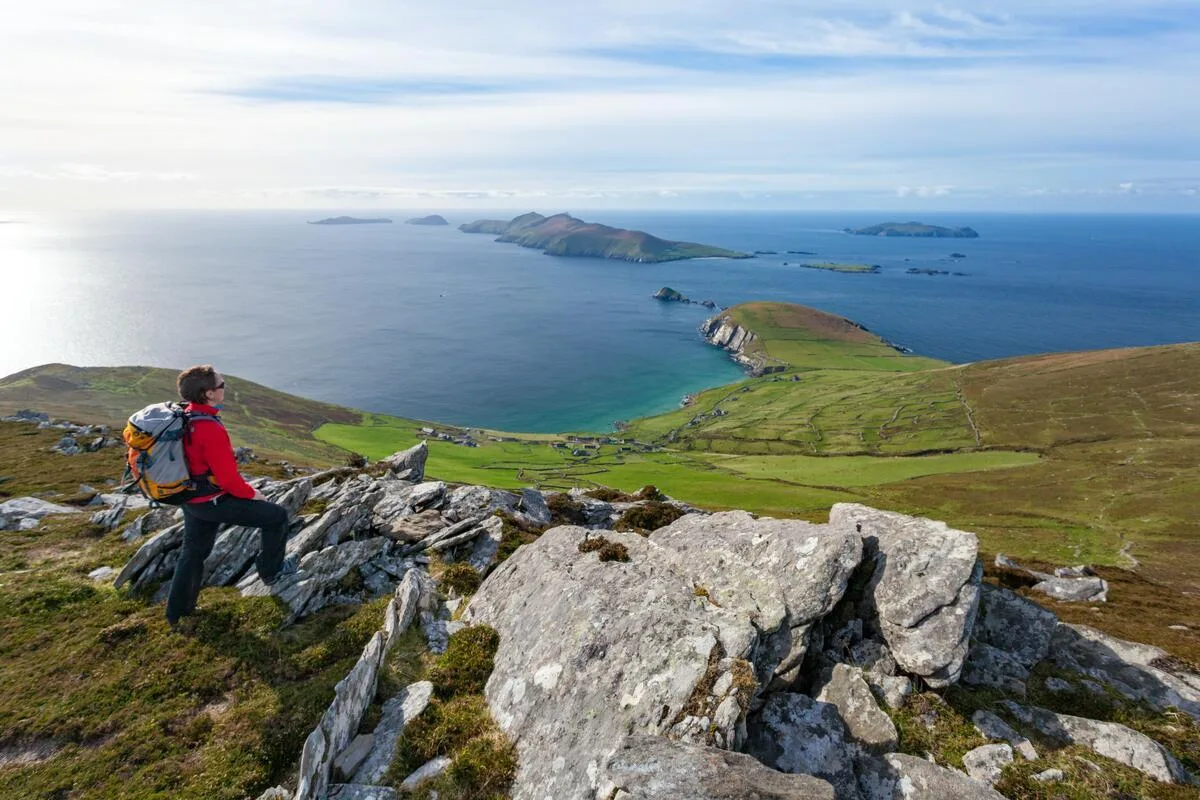
One of the most spectacular days on the trail. You climb out of Allihies through the abandoned mine workings, cross over the spine of the peninsula, and pick up the southern coast path with views across to Bere Island. If you have legs and time, the side trip out to Dursey Island and Ireland's only cable car is worth the detour. The day ends in Castletownbere, the busiest of the Beara towns and home to one of the country's biggest fishing fleets.
Day 6: Castletownbere to Adrigole (about 17 km)
A shorter walking day, which you'll be grateful for. The trail keeps to the southern shore of the peninsula, in and out of woodland and along quiet lanes. Hungry Hill rises ahead of you — the mountain Daphne du Maurier made famous in her novel about the Puxley family of Dunboy. Adrigole is little more than a junction, but it has a friendly pub and the best chowder on Beara.
Day 7: Adrigole to Glengarriff (about 24 km)
The final day is the toughest and the most rewarding. You climb out of Adrigole, cross the high ground below Hungry Hill, and descend through native oak woodland into Glengarriff. Bantry Bay opens out below you. The harbour, the warm-water Gulf-Stream gardens of Garinish Island, the seal colony — this is a soft, lush landing after a week in the wilder country to the west.
Day 8: Departure
Breakfast in Glengarriff, then your transfer back to Cork airport, Cork city, or Kerry — whichever way you're heading next.
This is the seven-walking-day version. If you have less time, our 5-day Beara Way tour picks out the best of the western half between Lauragh and Castletownbere. The 6-day version trims a stage; the 8-day version adds a rest day in Eyeries or Castletownbere, which we strongly recommend if it's your first long-distance walk.
Best Time to Walk the Beara Way
The Beara Way can be walked from mid-April to mid-October. Each part of the season has its own character.
April and May: Long daylight, fresh greens, gorse blooming bright yellow on the slopes, lambs in the fields, very few other walkers. Mornings are cool and the trail underfoot is still drying out after the winter. Our favourite time on Beara if you don't mind the chance of cold rain.
June and July: Peak walking weather. Long, light evenings — you can finish dinner and still go for a stroll along the harbour. The villages are awake and lively. Book accommodation early; rooms on the peninsula are limited.
August: Warm and busy. The Beara is still quieter than Kerry, but Allihies and Castletownbere fill up. The hills can be hazy in the afternoon heat.
September and early October: Our other favourite time. The light turns golden, the heather is still purple on the slopes, the crowds melt away, and the seafood in Castletownbere is at its best. Expect changeable weather — the Atlantic is gearing up for autumn.
How Hard Is the Beara Way?
It's a moderate trail. There are no scrambles, no exposed ridge sections, and no days where you need a map and compass in a navigation sense — the waymarking is reliable. What it does ask of you is the ability to walk 18 to 24 kilometres on six or seven consecutive days, with some ascent on most of them. The terrain is varied enough that nothing gets monotonous, but boots and a small amount of training matter.
Compared to the Kerry Way, Beara is gentler underfoot but slightly more remote. Compared to the Wicklow Way, it has less sustained mountain crossing but more coast and more village walking. Compared to the Dingle Way, it is quieter and less developed for visitors.
What to Pack for the Beara Way
We send all our walkers a full packing list before they come, but the essentials are these: a comfortable, broken-in pair of waterproof walking boots; a properly waterproof jacket (Gore-Tex or equivalent — not a rain shell); waterproof overtrousers; a small day pack with a rain cover; two warm mid-layers; one or two pairs of decent walking socks; a basic first-aid kit; a small head torch; a refillable water bottle; and sun cream — yes, even in Ireland. You don't carry your main luggage. Your bags are moved from B&B to B&B by our transfer driver each day.
Where to Eat and Drink Along the Way
Beara eats well. In Kenmare, the choice is enormous for a town of that size. In Eyeries, Causkey's bar does a perfect afternoon pint and a sandwich. In Allihies, the Oak does excellent dinners. In Castletownbere, you eat fish that was landed that morning at MacCarthy's or the Olde Bakery. In Glengarriff, the Maple Leaf and the Eccles Hotel are old favourites.
You'll never go hungry on Beara. You may go slightly over budget on chowder.
Self-Guided vs Guided
The whole of the Beara Way is well waymarked with the standard yellow walking-man arrow, and the trail is friendly to self-guided walkers. That's how we send most of our guests — we book your accommodation, move your bags, give you detailed route notes and a map for each day, and you walk at your own pace. There's a phone number in your pack if anything goes wrong. Most days, nothing does.
If you'd prefer to walk with a guide, we can arrange that for groups of four or more on request. For solo walkers and couples, self-guided is what we recommend — it gives you the best of the trail's solitude.
How to Get to the Start (and Home Again)
The most common arrival is Cork airport, then a transfer to Kenmare (about 90 minutes). Kerry airport is also workable. From Dublin, take the train to Cork and pick up a transfer from there. Most of our guests fly into either Cork or Dublin and let us arrange the onward journey — there's no need to hire a car for the trail itself.
Frequently Asked Questions About the Beara Way
How long does it take to walk the Beara Way?
The full 196-kilometre loop is comfortably walked in seven days on the trail (eight nights including arrival and departure). Faster walkers can do it in six days. We don't recommend trying to compress it into less than five.
Is the Beara Way suitable for beginners?
It is if you've done some walking before. The terrain is moderate, the waymarking is good, and the daily distances are manageable on a properly paced itinerary. Complete beginners should consider a shorter option like our 5-day version, or start with a slightly easier trail like the Sheep's Head Way next door.
Can you walk the Beara Way alone?
Yes, and many of our walkers do. Solo walking on Beara is safe, social in the evenings, and gives you the best of the trail's quietness. We've sent solo walkers in their late 20s and solo walkers in their early 80s. Both have come back happy.
What's the difference between the Beara Way and the Beara-Breifne Way?
The Beara Way is the 196-kilometre loop of the Beara Peninsula. The Beara-Breifne Way is a much longer (500+ kilometre) national trail that follows the route of O'Sullivan Beare's 1603 march from Glengarriff to Leitrim — it uses the Beara Way as its first section. The Beara Way is the manageable, self-contained walk most people are looking for.
Do I need to book in advance?
Yes. Accommodation on the peninsula is limited — many villages have only one or two B&Bs — and rooms book out months ahead in summer. We recommend booking by January for a peak-season walk, and at least eight weeks in advance for the shoulder seasons.
Is mobile signal reliable on the Beara Way?
Mostly yes in the villages, patchy on the high ground and along the more remote coastal sections. This is part of the charm. Bring a paper map as a backup; we send you one.
Ready to Walk the Beara Way?
If you'd like to do this trail with us, our Beara Way self-guided walking holidays include all your accommodation, daily luggage transfers, detailed route notes and maps, hearty Irish breakfasts, and a real human (us) on the end of the phone for anything that comes up. Choose your duration — five, six, seven, or eight days — and we'll handle the rest.
If you have questions, we're easy to reach. The team has walked every step of this trail. We'd love to help you walk it too.