How to Prepare Weather Risks Irish Trails: Complete Guide
Weather Preparation for Irish Hiking: The Complete Safety Guide
A walker collapses on Carrauntoohil in August wearing only a fleece and soaked jeans. Mountain rescue brings him down with early hypothermia — on a day that started sunny and 18°C at the car park. Two hours later, a different group summits the same mountain in driving rain and 50 km/h winds, takes their photos, and walks down safely. Same mountain, same weather. Drastically different outcomes.
The difference wasn't luck. It was weather preparation done right.
Ireland's weather has earned its reputation: rapid change, Atlantic wind systems, frequent rain, sudden visibility loss, and the very specific danger of wet cold rather than extreme cold. These are real hiking weather risks, and they catch out walkers every year.
But here's what I've learned from twenty years on these trails: the weather itself isn't the danger. Unpreparedness is. This guide gives you a complete framework for safe walking in Irish weather — from the evening before your walk to the moment you decide whether to turn back.
Understanding Irish Trail Weather Risks
Before you can master weather preparation for Irish hiking, you need to understand what makes Irish mountain weather different from most European hill country.
Wet Cold: Ireland's Primary Hazard
The main weather risk on Irish trails isn't extreme cold. Our oceanic climate means temperatures rarely drop below freezing, even on high ground in winter. The hazard is wet cold — the lethal combination of rain, wind, and wet clothing that extracts body heat rapidly even at 10°C.
I've seen walkers shivering uncontrollably at temperatures that would be comfortable in dry conditions. A day at 10°C in still air is pleasant in a fleece. The same 10°C combined with a 35 km/h wind, rain, and wet base layers can produce a hypothermia risk within hours.
This single distinction shapes every gear choice you'll make for Irish walking.
It Changes Fast — In Both Directions
Atlantic weather systems move quickly across Ireland. A grey, overcast morning can clear to brilliant sunshine by noon. A clear afternoon can turn to driving rain in thirty minutes. That speed of change means three things:
- A bad forecast doesn't guarantee a bad walking day.
- A good forecast doesn't guarantee safety — conditions can deteriorate while you're on the hill.
- You must prepare for the worst forecast scenario, not the best.
High Ground Is a Different World
The weather at the trailhead bears no guaranteed relationship to conditions 600 metres above. Cloud base on Irish mountains often sits at 400–500 metres on days that feel mild in the valleys. Wind speed roughly doubles for every 600 metres of elevation. Temperature drops about 1°C per 150 metres.
I've started walks in shirtsleeves and needed full waterproofs and a winter hat within an hour. Always check forecasts specifically for mountain-level conditions, not general lowland weather.
The Forecasting System: Met Éireann Is Your Only Reliable Source
Met Éireann is Ireland's national meteorological service and the only forecast source with the station density and local knowledge to be reliable for Irish mountain conditions. The regional forecasts, dedicated mountain forecasts, and weather warnings Met Éireann provides are accurate in ways that generic weather apps simply aren't.
Check Met Éireann the evening before any hill walk. Look specifically at:
- Wind speed and direction at mountain height
- Precipitation probability and timing
- Temperature at altitude (in the mountain-specific forecast)
- Visibility forecasts
- Any weather warnings (Yellow, Orange, or Red)
Then check it again on the morning of your walk. Irish forecasts are significantly more accurate at 24 hours than at 48 hours — conditions can shift in ways the two-day forecast didn't capture.
Mountain-Specific Forecasts
Met Éireann publishes dedicated mountain forecasts for the Wicklow Mountains, MacGillycuddy's Reeks and other significant ranges. These are separate from county forecasts and specifically modelled for high-ground conditions. I check the mountain forecast for every walk over 400 metres. It has saved me from several miserable days and at least two genuinely dangerous situations.
Wind Chill: The Number That Actually Matters
Air temperature alone is meaningless for hiking safety in Ireland. Wind chill — the effective temperature accounting for wind speed — is what your body actually experiences. On a 10°C day with a 50 km/h wind, the wind chill is around 0°C. In wet conditions with inadequate clothing, that's hypothermia territory within two to three hours. Most weather apps show wind chill. Most walkers don't check it. Always check it.
Irish Mountain Gear: The Non-Negotiables
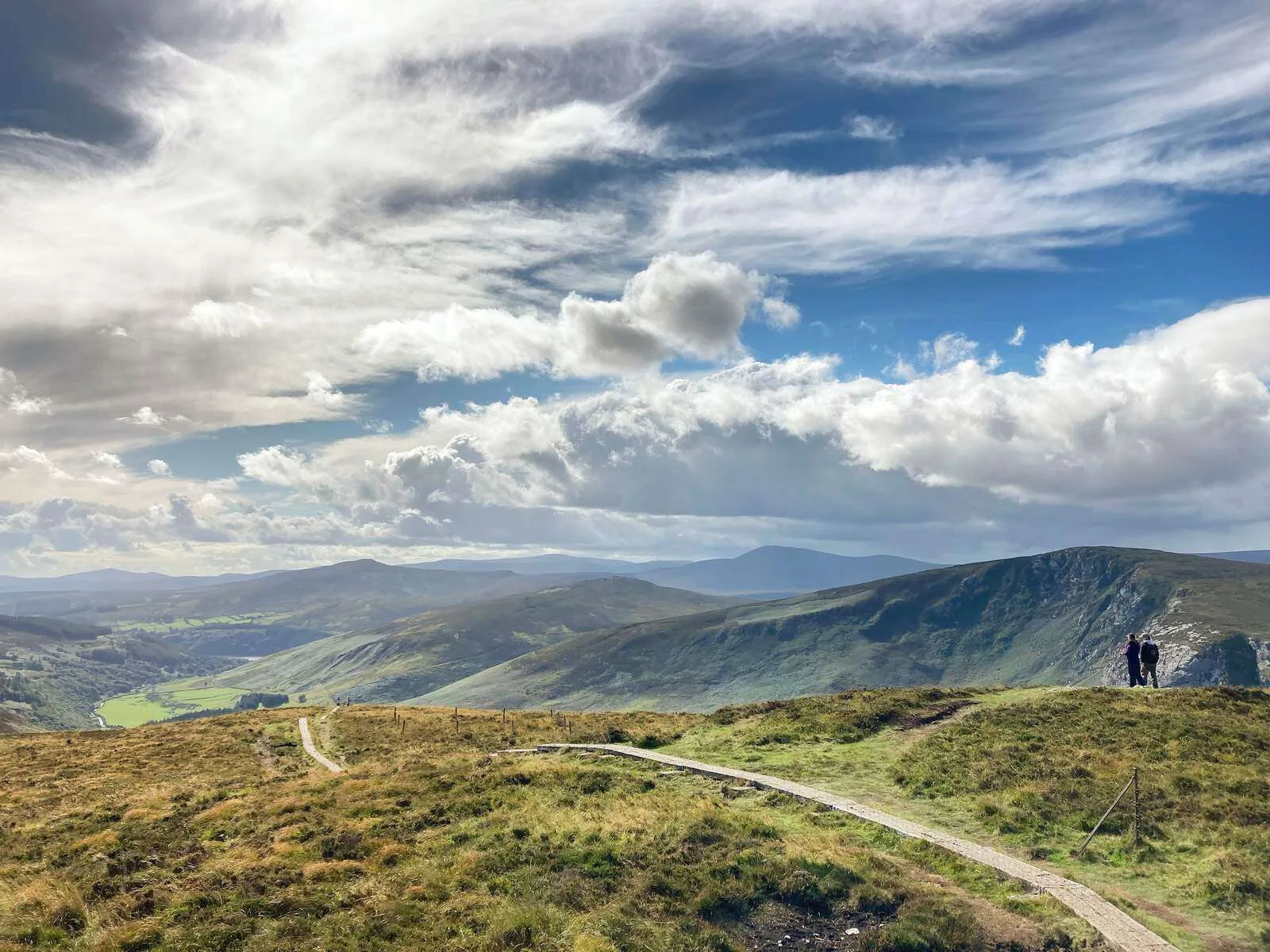
Waterproof jacket. Seam-sealed, genuinely waterproof (not water-resistant), and breathable. The difference isn't primarily cost — it's the seam sealing and breathability that determine whether you stay dry. A jacket that leaks after thirty minutes on an exposed ridge isn't a waterproof jacket.
Waterproof trousers. Almost universally underpacked and almost universally needed when conditions deteriorate. A waterproof jacket with non-waterproof trousers leaves your legs — which house your largest heat-generating muscle groups — soaked and cold. Pack them. You won't regret carrying them even if you don't need them.
Base layers. Merino wool or synthetic fabrics that wick moisture from skin. Cotton base layers are a safety hazard in wet mountain conditions — they absorb water, lose all insulating properties when wet, and accelerate heat loss. Never wear cotton next to your skin on Irish mountains. This is fundamental wet-cold prevention.
Mid layer. A fleece or synthetic insulating layer between the base and waterproof shell. Adds thermal protection when stopped and provides warmth if the shell alone proves insufficient.
Hats and gloves — even in summer. Temperatures on exposed Irish summits can drop to 5°C or below on days that feel mild in the valley. A warm hat and windproof gloves weigh almost nothing and matter considerably on an exposed ridge.
Emergency foil blanket. Under 100 g, and they have saved multiple lives on Irish mountains. Hypothermia progresses fast — the minutes between calling for help and mountain rescue arriving are minutes where a foil blanket makes an extraordinary difference. I carry one on every walk over 300 metres. It has never left my pack unused, but I'll never walk without it.
For a full kit list see our walking holiday packing checklist.
Navigation Essentials for Poor Visibility
Reliable navigation tools are part of weather safety, because poor visibility is one of the conditions you must be prepared to navigate through.
| Item | Purpose | Why it matters |
|---|---|---|
| 1:25,000 OS map | Primary navigation | Paper doesn't run out of battery |
| Compass | Bearing navigation in fog | The difference between safety and walking in circles |
| Fully charged phone | Emergency contact | Mountain rescue coordinates through 999/112 |
| Power bank | Phone backup | Cold drains batteries fast |
Download digital maps to your phone as backup. Carry the paper version as your primary tool. Know how to use a compass with a map — in zero-visibility fog, that skill is what gets you down safely.
The Go / No-Go Decision Framework
Use these criteria the morning of your walk to decide whether to start.
| Go if | Reconsider if | Don't go if |
|---|---|---|
|
|
|
On the Trail: Three Warning Signs
Once you're walking, three conditions should trigger immediate reassessment.
1. Conditions are worse than forecast. If the weather is significantly worse than the morning's forecast suggested, it may continue deteriorating. Forecasts have margins of error — actual conditions are more reliable than predictions.
2. The slowest walker is struggling. Pace is the fastest indicator of deteriorating comfort. If your slowest member is moving significantly slower than normal or showing signs of cold (shivering, slurred speech, loss of coordination), descend immediately. I've turned groups back dozens of times based on this sign alone. It has never been the wrong call.
3. You can't confirm your position. If visibility drops so you cannot identify your location on the map, stop. Don't continue on dead reckoning over unfamiliar terrain. Either wait for clearance, navigate carefully with compass bearings to a known landmark, or retrace your steps.
The Turn-Back Decision
Turning back isn't failure. Turning back is the correct decision when conditions exceed your group's capability. The summit will be there another day. The specific Irish mountain risk is that walkers who push on through deteriorating conditions reach a point where turning back becomes as hazardous as continuing — and continuing is already dangerous. The rule is simple: turn back early, not late.
Specific Hazards by Weather Type
Rain
Rain itself isn't the hazard — wet clothing and inadequate waterproofing are. A properly waterproofed walker can walk all day in Irish rain without significant risk. The secondary rain hazard is trail conditions: wet grass, wet rock, and wet mud all affect footing dramatically. Wear boots with genuine grip on wet surfaces, and use poles on steep wet descents.
Wind on Irish Ridges
Wind is the most underestimated hazard on Irish upland trails. Irish mountains, particularly those in the west and south, take the full Atlantic wind without the protective tree cover of continental ranges. On exposed ridges above 400 metres, wind speeds frequently exceed 50 km/h and occasionally exceed 80 km/h in stormy conditions.
These aren't walking-into-a-headwind speeds. These are winds that knock people over.
Wind also dramatically accelerates heat loss when combined with rain. A 40 km/h headwind in driving rain extracts heat from even well-clothed bodies at rates that make extended exposure genuinely dangerous.
The wind decision rule: if you're struggling to walk against the wind or being unsteadied by gusts, leave exposed terrain immediately. Descend into valleys or below the treeline where wind speed drops substantially. There's no shame in choosing a sheltered valley walk on a windy day — it's the right call.
Fog and Low Cloud
Fog destroys navigational confidence in walkers who rely on visible landmarks rather than maps and compasses. The rule in fog: slow down, maintain compass heading, and confirm position at every identifiable landmark.
Never descend steep slopes in fog if you don't know exactly where you are. Irish mountain terrain frequently features crags, gullies, and cliffs that are invisible in fog until you're at the edge. I've navigated dozens of groups down through fog using compass bearings. It requires concentration, frequent position checks, and willingness to stop if you're not certain.
Lightning
Thunderstorms are relatively rare in Ireland but they do occur, particularly in summer. On exposed ridges and summits, lightning is a genuine lethal hazard. The rule: if thunderstorms are forecast, don't go onto high ground. If you find yourself in a thunderstorm on high ground, descend quickly and safely. Avoid lone trees, standing structures, and the highest ground.
Seasonal Patterns to Plan Around
The character of Irish weather risks shifts through the year. Winter brings short days, the highest winds, and the only realistic chance of snow and ice on the mountains. Spring is the most stable season for high ground — long enough days, drier conditions, and lower wind. Summer brings the warmest temperatures but the most thunderstorm risk and the longest possible days for ambitious routes. Autumn brings spectacular colour but also the first big Atlantic storms. Match your route ambition to the season and you'll halve the weather risks before you even pack your bag.
Summary: Atlantic Weather Hiking Preparation
Understanding how to prepare for weather risks on Irish trails turns Irish weather from an anxiety into something you can plan around.
- Check Met Éireann mountain forecasts the evening before and morning of your walk.
- Pack for the worst forecast scenario, not the best.
- Understand that wet cold, not extreme cold, is Ireland's primary hazard.
- Carry genuine waterproofs (jacket and trousers), proper base layers, and emergency equipment.
- Make go/no-go decisions based on wind speed, visibility, and group capability.
- Turn back early if conditions deteriorate — the summit isn't worth a rescue operation.
The walkers who experience the finest days on Irish trails are the ones who understand conditions well enough to embrace them — rainy days included.
Plan Your Walking Holiday with Weather Confidence
If you'd like to discuss any of this in the context of planning a specific walking holiday in Ireland — where I handle the logistics, accommodation, and route planning while you focus on the walking — I'm happy to help. Every Walking Holiday Ireland itinerary builds in weather flexibility and includes detailed preparation guidance for the specific trails you'll walk.
Drop me a message through the contact page or WhatsApp me on +353 87 957 3856.
— Cliff, Walking Holiday Ireland
Frequently Asked Questions
What is the biggest weather danger when hiking in Ireland?
Wet cold is the biggest danger, not extreme cold. The combination of rain, wind, and wet clothing can produce hypothermia at temperatures as mild as 10°C. Wind chill on exposed ridges combined with soaked base layers is what catches most walkers out, which is why genuine waterproofs and non-cotton layers are essential.
What wind speed is too high for hiking in Ireland?
Below 50 km/h at walking height is generally safe for most upland walking. Between 50 and 60 km/h, reconsider exposed ridge routes. Above 60 km/h at altitude, choose a sheltered valley walk instead. Above 80 km/h or when an Orange weather warning is in place, stay off the mountains entirely.
Do I need waterproof trousers for hiking in Ireland?
Yes. Waterproof trousers are almost universally underpacked and almost universally needed when Irish conditions deteriorate. Your legs house your largest heat-generating muscles, and wet legs drain body warmth fast. Carry them on every mountain walk, even in summer.
Where do I get accurate Irish mountain weather forecasts?
Met Éireann is Ireland's national meteorological service and the only reliable source for mountain conditions. They publish dedicated mountain forecasts for the Wicklow Mountains, MacGillycuddy's Reeks, and other ranges, with wind speed at altitude, freezing level, and visibility. Check it the evening before and again the morning of your walk.
When should I turn back on an Irish mountain walk?
Turn back when conditions are significantly worse than forecast, when your slowest walker is struggling or showing signs of cold, or when visibility drops so you cannot confirm your position on the map. Turning back early is always safer than turning back late. The summit will be there another day.
Frequently Asked Questions
What type of waterproofs do I need?
What happens in cases of force majeure (severe weather, natural disasters, etc.)?
Is 24/7 emergency support really available?
Photo Gallery