How to use a compass on the trail
How to use a compass on the trail
One of the most critical things any hillwalker or outdoor adventurer should learn is how to use a compass on the trail. With this skill, you can figure out where you are, plan a route, and get around accurately in any terrain. Learning how to use compass hiking techniques is essential for anyone venturing into unfamiliar Irish mountain country, from the Wicklow Way to Connemara's rugged passes.
Index how to use compass hiking
As we all know, compasses show four cardinal directions: north, south, west, and east. But following such vague directions in the wilderness can lead to confusion, mistakes, and sometimes even disaster. Understanding how to use compass hiking methods prevents these common navigation errors.
Given this, before going into the wilderness, hikers, campers, and mountaineers should put aside time to learn how to use a compass and take compass bearings.
This skill is simple, as shown in our straightforward, step-by-step instructions.
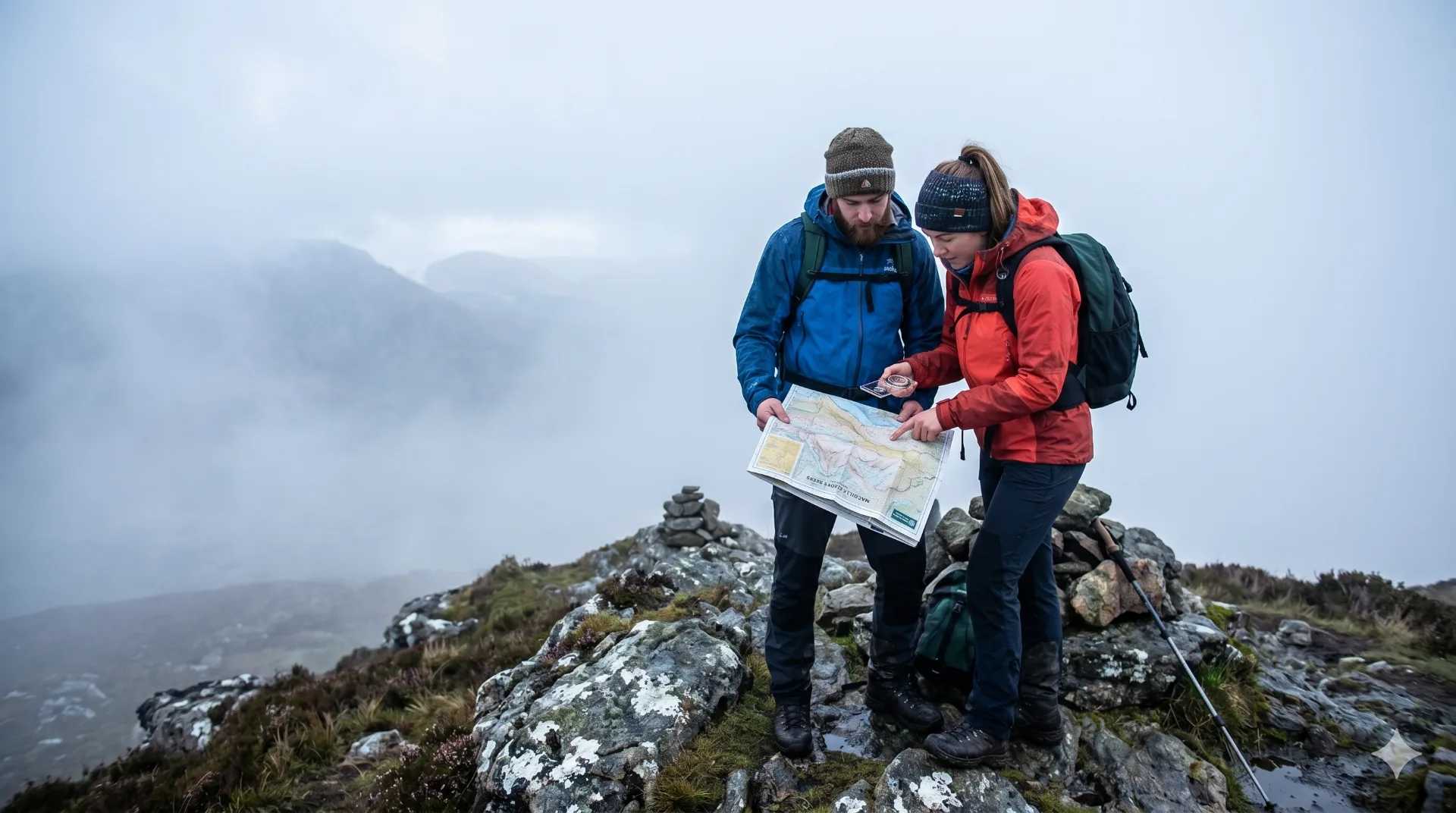
Are You Ready to Learn More About Compass Bearings?
- Take an ocular bearing.
- Make adjustments for magnetic declination.
- Arrange your map
- Obtain a bearing
- Triangulate your position precisely.
What You'll Need To Follow Along With This Tutorial
A compass and a topographical map are needed to read bearings in the field. Before you head out on any of our recommended GPS and navigation devices, master these fundamentals with traditional tools.
What kind of Compass should I use?
Depending on your preferences, you can use a baseplate or a thumb model. On the other hand, baseplate compasses have different characteristics not found in thumb compasses that make them more exact, better for charting distances, and easier to use when getting a bearing. For serious hikers wanting to master how to use compass hiking in challenging terrain, the baseplate compass is the standard choice.
Maps, what should I look for
Detail, revision date, and type are the three most important things to consider when choosing a map. It is always a good idea to obtain the highest detailed topo map you can locate (1:25.000 or even 1:10.000). This will let you navigate more precisely when you learn how to use compass hiking. Because the magnetic declination value of specific places changes over time, having the most up-to-date version is crucial for successful and precise navigation.
Finally, it should go without saying that you'll need a topographic map—a tourist or road map will be useless out in the wilderness.

What Is A Compass Bearing?
There are two simple methods for navigating with a bearing. Before we get there, let's look at how to set up your map.
Step 1: Make adjustments for magnetic declination.
The area's declination value should be provided in the map's legend. Turn the housing clockwise (west) or counterclockwise (east) until the index line at the base of the direction arrow shows the correct value, depending on the declination value for the area. If the declination value is 6° west, turn the housing 6° clockwise. Keep in mind that an east declination is a positive number, and a west declination is a negative number.
Step 2: Center Your Map on True North.
Triangulating Your Position and Taking a Sight Bearing
You're now ready to take a bearing with your map and compass. To do this, you must figure out the angle between Magnetic North and a distant object on the land. The visual or sight approach is the simplest way to achieve this, as it allows you to figure out where you are by using a visible landmark. This is how it's done.
Step 1: Find a landmark.
Maintain a level and steady grip on the compass. Aim the direction-of-travel arrow at a prominent feature in the terrain. This could be a mountain, a bend in a river, the edge of a forest, a campsite, or anything else that stands out.
Step 2: Line up the magnetised needle with the orienting arrow.
Turn the bezel ring until the magnetic needle is centred within the orienting arrow. Take note of the bearing just below the index line.
Step 3: Adjust for Magnetic Declination
Unless you have a compass that permits you to "set it and forget it," your reading will be off by the same number of degrees as the area's declination value!
Step 4: Draw a line from the landmark to the point of interest following the bearing
Place the compass on the map, ensuring that the lines that help you determine north and south are parallel to the map lines. Place the compass so that the baseplate's top end points toward the landmark you want to find. Then, following the bearing you just took, draw a long line from the historic.
Step 5: triangulate and repeat twice more.
Steps 1–3 should be repeated twice more with two distinct landmarks or features. Your position will be inside the triangle made by the three lines you drew meeting.

How To Use A Compass On The Trail And Take A Bearing
Now that you know where you are, you may calculate a course to your target.
While this step is not always required, it can assist you in navigating past obstructions (cliffs, steep inclines, boulder fields, lakes). It's especially useful when trekking in low light, allowing you to divide your journey into short pieces between waypoints (aka way-points/waymarkers) to ensure you stay on track. For comprehensive safety guidance on Irish hiking, always carry and know how to use compass hiking skills alongside other navigation methods.
Step 1: Locate Waypoints
Mark a series of easily identifiable landmarks or elements on your map between your starting location and destination.
Step 2: Connect each waypoint with a line.
To "connect the dots," draw a line between each waypoint using the ruler edge and a pencil.
Step 3: Assess Your Situation
Place your compass on top of your topographical map. Place the baseplate's edge along the line drawn between point A (your current location) and point B. (your first waypoint).
Turn the bezel so that the orienting lines match the north-south grid lines and the north marker points to the top of the map. Read the bearing beneath the index line, correct for declination, and then repeat Step 3 for the remaining legs of your route (Points B to C, D, E, etc.).
Step 4: Keep Your Bearing
The bearings you took in Step 3 inform you which way to go on each leg of your planned itinerary.
Here's how to walk on a bearing and follow each one.
- Adjust your compass to the bearing you took for this leg of your travel, remembering to add/subtract the declination figure. Rotate your entire body until the magnetised needle rests inside the orienting arrow.
- The direction you are now facing is the direction you must travel. Keep your compass in your grasp as you walk to avoid becoming lost. It's also a good idea to look for minor things in the distance that you may use as intermediates along the way.
It's time to get out there and practice!
After reading the previous instruction, we hope you agree and can understand how beneficial the ability to take bearings can be in the outdoors. Now that you've learned the fundamentals of how to use compass hiking, it's time to put them into practice. Get your instruments ready and go take some measurements! For inspiration, explore some of our best Irish walking trails where you can apply these navigation skills.
How did you find our bearing-taking guide? We'd love to hear how things went!
Ready to Start Your Irish Walking Adventure?
Let us take care of the details — accommodation, luggage transfers, and route notes — so you can focus on enjoying every step of your journey through Ireland's remarkable landscapes.