Saint Brigid's Impact on Irish Culture: Walk in the Footsteps of Ireland's Beloved Saint
Saint Brigid Irish Heritage: Walk in the Footsteps of Ireland's Beloved Saint
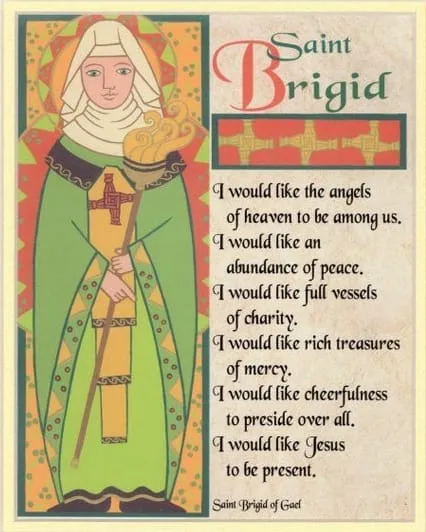
She is Ireland's other patron saint. Not as famous as Patrick, perhaps—but, for many, far more deeply felt.
Saint Brigid of Kildare represents a fundamental part of Saint Brigid Irish heritage and is woven into Irish life in ways that go back over fifteen centuries. Her name appears on schools, hospitals, rivers, and holy wells. A cross made of rushes hangs in kitchens across the country. And every first of February, Ireland marks St Brigid's Day—now a national public holiday—in her honour.
If you walk Ireland's trails and wonder why you keep encountering her name in old abbey ruins, carved stone fonts, or roadside shrines – the answer is her story.
Who Was Saint Brigid? Understanding Irish Heritage
Saint Brigid was born around 451 AD, most likely in Faughart, County Louth — just a short distance from where the Cooley Mountains meet the coast. The details of her early life blend history and legend, as they do with most figures from early Christian Ireland.
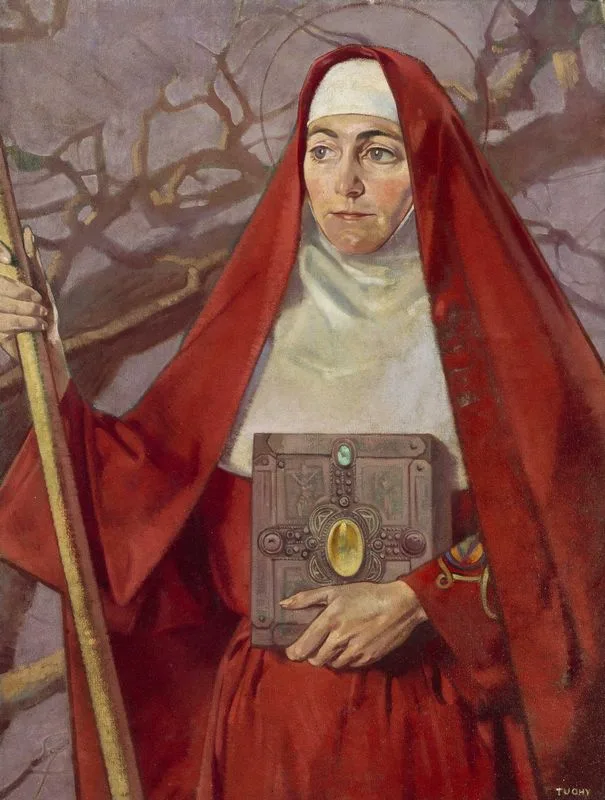
According to tradition, she was the daughter of a pagan chieftain and a Christian slave woman. From a young age, she gave away food and belongings to anyone in need — a habit that apparently drove her father to distraction. One account says he tried to sell her to the king of Leinster, but when the king asked why she was giving away his jewelled sword to a beggar, she explained simply that she would give away everything she owned to serve God. The king was so moved that he freed her.
She founded a monastery at Kildare around 480 AD. The name itself – Cill Dara, meaning "church of the"oak"—tells you something about the land she chose: an ancient sacred oak grove, already significant to the pre-Christian Irish. This was not coincidence. Brigid had a gift for meeting people—and their faiths—where they were.
Her monastery became one of the most important centers for education, art, and hospitality in early Christian Europe. It was home to the Book of Kildare, an illuminated manuscript said to rival the Book of Kells (though it no longer survives). She died around 524 AD and is buried, according to tradition, at Downpatrick in County Down alongside Patrick and Columba.
Saint Brigid Irish Heritage and the Goddess Before Her
Here is where the story gets fascinating.
Long before Christianity arrived in Ireland, the Celts worshipped a goddess named Brigid — a deity of fire, healing, poetry, and craft. The Christian feast day of Saint Brigid falls on 1st February, the same date as Imbolc, the ancient Celtic festival marking the beginning of spring.
Whether this blending is deliberate or simple chronological coincidence, scholars have debated for generations. What most agree on is that Saint Brigid became a bridge between the old world and the new – absorbing the warmth and power of the goddess figure into a Christian framework that the Irish people already understood and loved.
This phenomenon is why Brigid feels different from other saints. She is not austere or forbidding. She is associated with fire, the hearth, the warmth of milk and grain, and the first lambs of spring. Her feast day is still marked in many parts of Ireland with the making of rush crosses – a ritual said to originate with Brigid herself, who wove a cross from the reeds of her father's sickbed to explain the story of Christ.
The Saint Brigid Cross: A Symbol Still Very Much Alive
The Saint Brigid's Cross is one of the most recognisable symbols in Irish culture. Made from rushes or straw, woven into a distinctive four-armed pattern, it is traditionally hung above the door of a home on St Brigid's Day to bring protection and blessing through the year ahead.
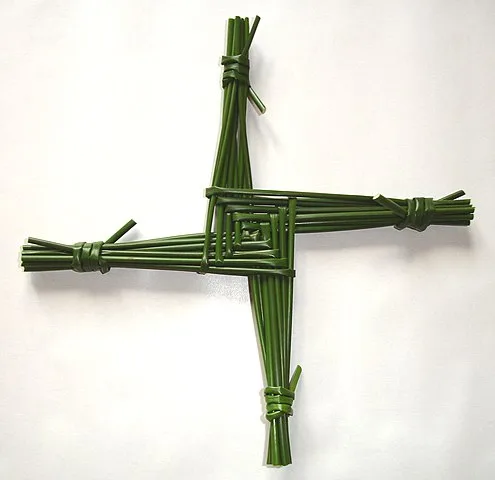
It looks nothing like a standard Christian cross. Its symmetry has far older roots — some historians trace similar designs to the pre-Christian Iron Age. This is part of what makes it so compelling: a symbol that belongs to both worlds simultaneously.
You will see the cross in farmhouses, pubs, and heritage centres all across Ireland. But you are most likely to encounter the living tradition of cross-making in rural communities, particularly in counties Kildare and Louth and along the River Barrow Valley.
What is Saint Brigid the patron saint of?
St Brigid is the patron saint of Ireland but also specifically of blacksmiths, healers, poets, and dairy farmers. The range tells you something: this is a saint for the people who worked with their hands, tended fires, made things, and fed others.
She is also a patron of children born out of wedlock – a reminder of her own origins, born to a slave woman who had no legal standing in Irish society. This compassion for the vulnerable and the overlooked runs through all the stories told about her.
Holy wells dedicated to Brigid, scattered across the Irish landscape, reflect her association with healing. Many are still visited by pilgrims today, particularly on her feast day, when people tie strips of cloth—called "clooties"—to nearby trees as acts of prayer or petitions.
Walking in Brigid's Ireland: The Places That Carry Her Story
Ireland's walking trails pass through landscapes shaped by Brigid's life and legacy. You do not need to be on a formal pilgrimage to feel her presence on the trail, but knowing the stories transforms a walk into something much richer.
Faughart, County Louth
Faughart is widely accepted as Brigid's birthplace. A quiet hillside shrine above the village holds a holy well dedicated to her, along with a small outdoor Stations of the Cross. The views stretch across the Cooley Peninsula and down towards the coast.
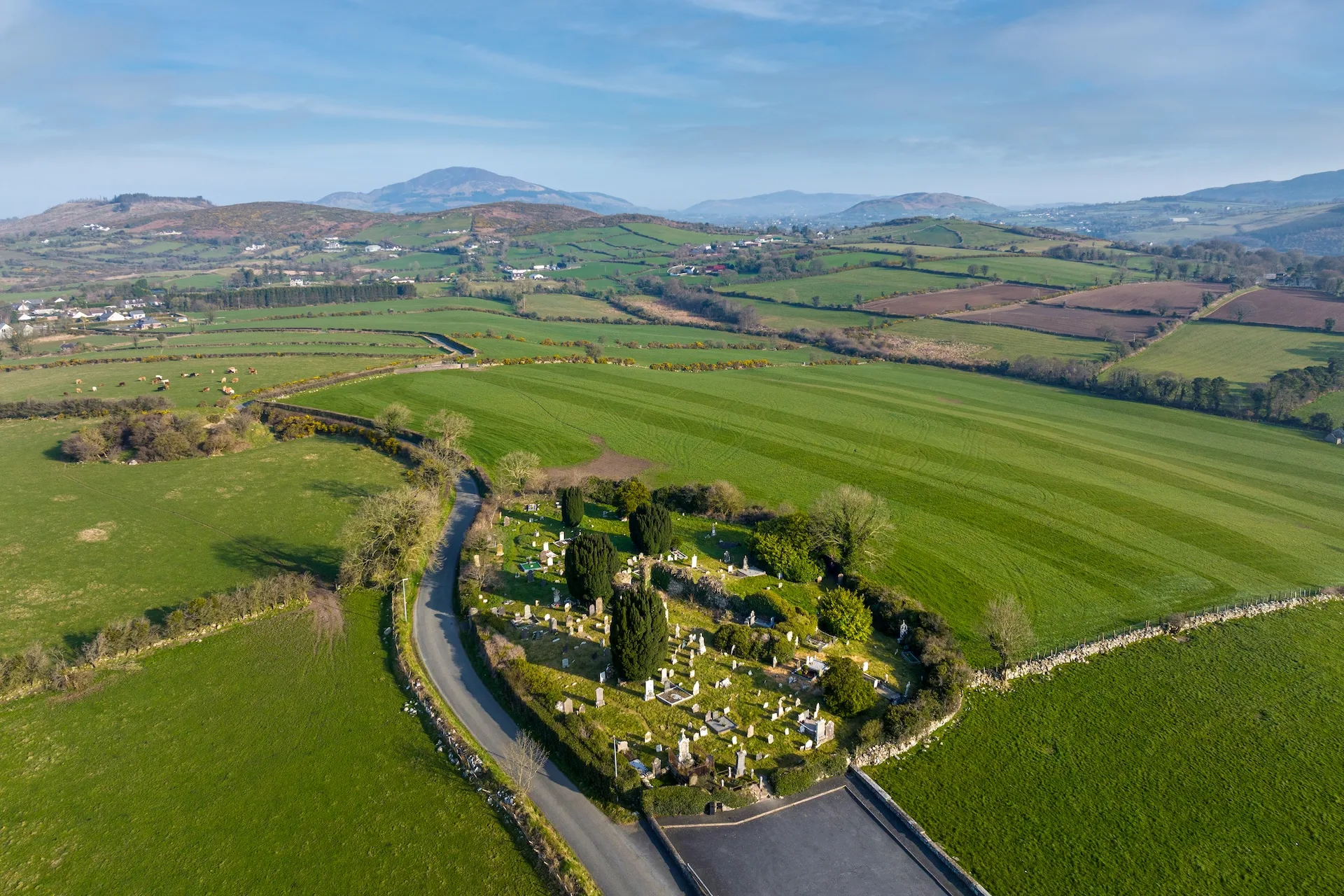
Walkers on the Cooley Peninsula circuit can combine a visit to Faughart with the broader Cooley landscape – a region steeped in Irish mythology, Iron Age history, and the legends of Cú Chulainn. It is one of the most historically layered walking areas in Ireland. Our Cooley and Mournes hiking tour brings you right through this territory.
Kildare Town
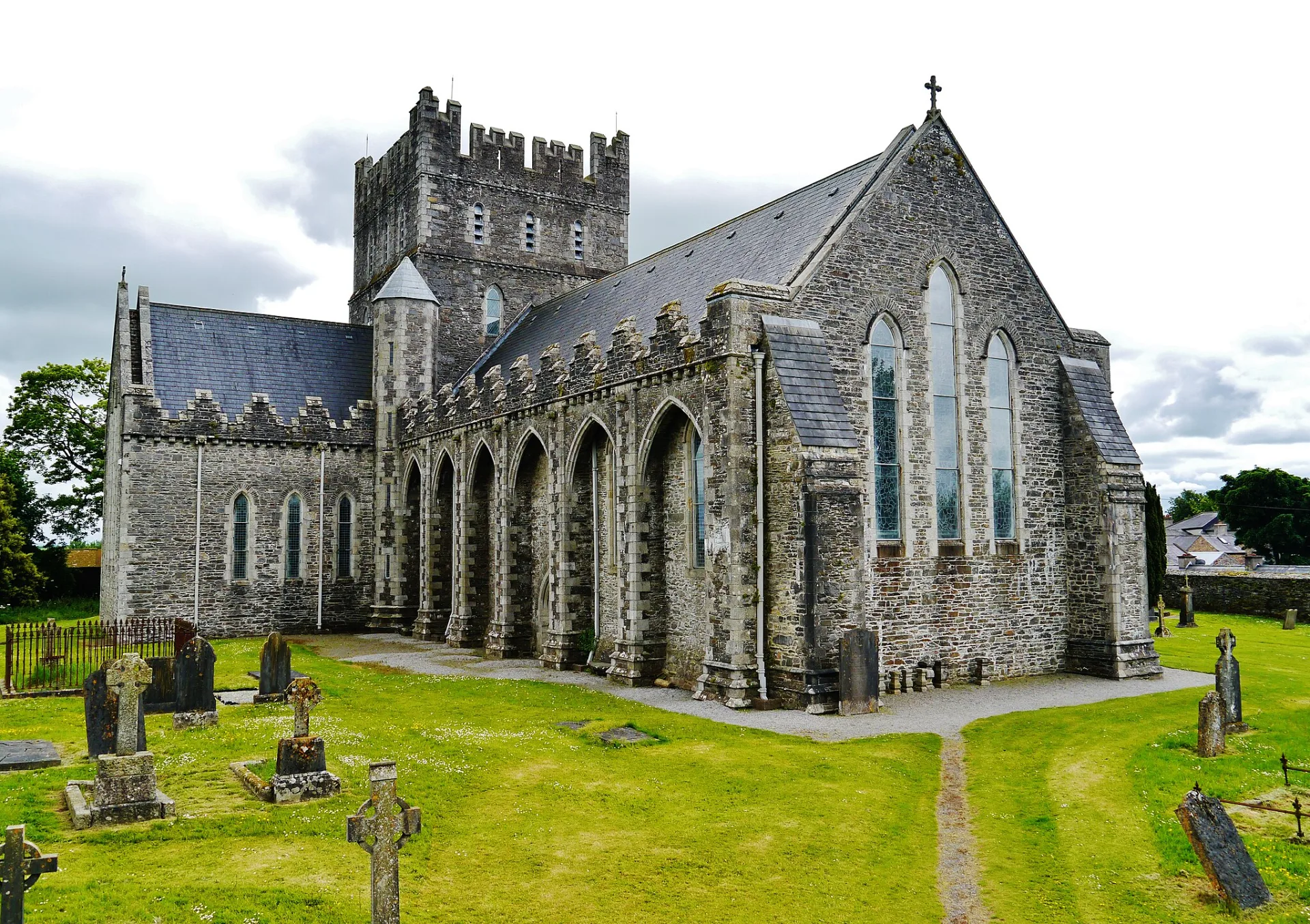
Saint Brigid's Cathedral in Kildare stands on the site of her original monastery. The round tower in the cathedral grounds is one of the best-preserved in Ireland. Inside, a fire pit marks the spot where a sacred flame—first lit by Brigid herself, according to tradition—burned continuously for centuries before being extinguished at the Reformation. It was relit in 1993 and burns again today.
Kildare sits close to the River Barrow, and walkers on the Barrow Way pass through some of the most peaceful countryside in Ireland's ancient east. It is easy to add a day in Kildare town to any Barrow Way itinerary. Our full Barrow Way walking holiday takes you through this entire region at a pace that lets you breathe it all in.
The Irish Pilgrim Paths
Ireland has a network of Irish pilgrim paths — ancient routes that pre-date the road network and are used by monks, saints, and ordinary people travelling between sacred sites. Brigid indirectly connects to several of these paths through the web of early Christian monasticism she helped shape.
The St Finbarr's Pilgrim Path in West Cork and the Cnoc na dTobar pilgrim path in County Mayo both carry the same spirit of contemplative walking through wild Irish landscapes that Brigid's story embodies. These routes offer a unique experience that a standard hiking holiday cannot provide, especially if you find solace in walking as a form of reflection.
Saint Brigid's Legacy in Modern Irish Life
For a figure who lived over fifteen centuries ago, Brigid's influence on everyday Irish life is remarkable.
St Brigid's Day became Ireland's newest national public holiday in 2023. It is celebrated on the first Monday in February each year — the first new public holiday Ireland has introduced in over thirty years. The decision was broadly welcomed as an acknowledgement of both Brigid's cultural significance and, in a wider sense, the role of women in Irish history.
Schools, hospitals, bridges, and GAA clubs across the country carry her name. The Liffey is not named after her, but the River Bride in Cork and several others are believed to derive their names from Brigit or related forms.
Her influence on Celtic culture and Irish heritage is explored in detail in our article on Celtic culture and history—well worth reading alongside this one if you want a broader picture of how pre-Christian and early Christian Ireland shaped the landscape you walk through today.
Why Brigid Matters to Walkers in Ireland
You might wonder: why does a walking holiday company care about a fifth-century abbess?
The truth is, walking in Ireland is not solely about the distance. Every trail passes through layers of history — stone walls built by famine survivors, ring forts used by Iron Age farmers, and monastic ruins that were once the intellectual heart of Europe. Saint Brigid is part of that story.
When I walk the Barrow Valley or climb into the Wicklow hills, I am aware that people have walked these same routes for over a thousand years — for trade, for prayer, for survival, for the simple love of the land. That continuity is part of what makes hiking in Ireland so different from walking anywhere else.
If you are interested in ancient traditions and Irish heritage pilgrimage walks or want to understand the spiritual dimension of Ireland's landscape, Brigid is an excellent starting point. Her story connects the mythological, the historical, and the deeply personal in a way that is very Irish.
Frequently Asked Questions About Saint Brigid
Who was Saint Brigid of Ireland?
Saint Brigid of Kildare (c. 451–524 AD) was one of Ireland's three patron saints, alongside Patrick and Columba. She founded a monastery at Kildare around 480 AD and is remembered for her charity, her gift for healing, and her role in shaping early Christian Ireland. Her birthplace is traditionally given as Faughart in County Louth.
What is St Brigid the patron saint of?
St Brigid is the patron saint of Ireland but also of blacksmiths, healers, dairy farmers, and poets. She is associated with fire, spring, and the hearth — qualities that reflect both her Christian life and her connection to the pre-Christian goddess of the same name.
What is the Saint Brigid's Cross, and what does it mean?
The St Brigid's Cross is a woven cross made from rushes or straw, traditionally created on 1st February – St Brigid's Day. It is hung above the door of homes and farm buildings to bring protection through the year. The distinctive four-armed design has both Christian significance and roots in older Celtic symbolism.
When is St Brigid's Day in Ireland?
St Brigid's Day falls on 1st February each year, coinciding with the ancient Celtic festival of Imbolc, which marks the start of spring. Since 2023, it has been a national public holiday in Ireland, celebrated on the first Monday of February.
Is there a connection between Saint Brigid and the Celtic goddess Brigid?
Yes — and it is one of the most intriguing questions in early Irish studies. The Celtic goddess Brigid was associated with fire, healing, poetry, and craft. Her feast day falls on 1st February, the same date as St Brigid's Day. Many scholars believe the Christian Saint Brigid absorbed qualities and traditions from the goddess figure, creating a seamless continuity between the old Irish faith and the new.
Can I walk to places connected with Saint Brigid in Ireland?
Yes. Faughart in County Louth—near the start of the Cooley Peninsula walking area—is Brigid's traditional birthplace, and it has a holy well and shrine. Kildare town, accessible from the Barrow Way, holds her cathedral and the site of her original monastery. Several Irish pilgrim paths also pass through landscapes shaped by the early Christian monastic tradition she helped found.
Plan Your Own Walk Through Brigid's Ireland
The excellent news is that Ireland's best walking trails run through precisely the landscape that shaped Brigid's life. You do not need to plan a separate "pilgrimage trip" — you just need to walk.
The Barrow Way traces the River Barrow through Ireland's ancient east, passing close to Kildare and through countryside that has barely changed in a thousand years. The Cooley Peninsula brings you to Brigid's birthplace and into a landscape layered with pre-Christian and early Christian history.
All our walking holidays are self-guided — you walk at your pace, with accommodation we have personally selected and luggage transferred between stops each day. There is no group to keep up with, no fixed timetable. Just you, the trail, and the story of the land.
If you have questions about any of our routes or want to talk through which walk suits you best, get in touch directly.
📞 +353 87 957 3856 | ✉️ info@walkingholidayireland.com | Contact page
You Might Also Enjoy
Celtic Culture and History in Ireland
Irish Pilgrim Paths: A Walking Guide
Ancient Traditions and Irish Heritage Pilgrimage Walk
Frequently Asked Questions
Are the trails well-marked?
What is the most popular route?
What kind of boots should I wear?
What are the most essential items to pack for a walking holiday in Ireland?
Photo Gallery