Irish Culture for Visitors: Songs, Music and Traditions You'll Encounter on Your Walking Holiday
Irish Culture Visitors Guide: What You'll Encounter on Your Walking Holiday
There's a moment on every Irish walking holiday when the landscape does something unexpected. Not a view — though the views are constant — but a sound. Music drifting from a village pub at nine in the evening. A fragment of the Irish language on a road sign that suddenly makes you aware you're somewhere genuinely different. A match playing on the pub television that has the whole room breathing together.
This irish culture visitors guide reveals that culture is not confined to heritage centres or tourist videos. It's alive in the places walkers pass through: pubs, village squares, roadside shrines, GAA pitches glimpsed through gaps in stone walls. Understanding a little of what you're seeing — the context behind the music, the language, the landscape names — transforms a walking holiday into something considerably richer.
This guide covers the cultural elements you're most likely to encounter on WHI's trails: traditional music, the Irish language, pub customs, GAA, Irish festivals, and the specific cultural character of each region.
Traditional Irish Music: Key Element of the Irish Culture Visitors Guide
What trad is — and isn't
Traditional Irish music — called trad — is not background music. It's a participatory art form that has been passed between generations in kitchens and pubs for several hundred years without, until relatively recently, being written down. The repertoire consists primarily of dance music: reels, jigs, hornpipes, polkas, and slow airs. The instruments — fiddle, uilleann pipes, tin whistle, bodhrán, flute, concertina, guitar, bouzouki — come and go from session to session. There's no bandleader, no set list, no stage. Musicians sit in a circle and play.
What you'll hear in a trad session is astonishing in its precision and drive. Reels at 120 beats per minute, every note clean, musicians who've never played together finding each other through familiarity with the same 2,000-song shared repertoire. It looks effortless. It isn't.
Our Celtic music and the tin whistle guide covers the instruments and tradition in depth.
Where to find trad sessions on WHI trails
Trad is not everywhere, and it's not every night. The sessions that matter happen in small rooms in small towns, usually starting late in the week, often spontaneously.
Dingle has the finest concentration of regular trad sessions on any WHI trail. Multiple pubs hold sessions weekly, the musicians are serious, and the tradition in this Gaeltacht town is particularly strong. Walkers finishing a day on the Dingle Way coast arrive in Dingle on evenings when the town is at its most alive.
Kenmare on the Kerry Way reliably delivers trad several nights a week in season, particularly Thursday through Saturday. The sessions here are community sessions — a mix of visitors and locals, which is precisely what makes them real.
Cushendall in the Glens of Antrim has a trad culture rooted in the area's strong Gaelic heritage. The Glens were one of the last Irish-speaking areas of Antrim and the music here carries that depth.
Graiguenamanagh on the Barrow Way has occasional sessions in the Duiske Arms that give the river town a musical dimension matching its mediaeval architectural character.
What to do in a session
Sit close. Don't clap between tunes — in a real session, sets of three or four tunes run together without pause. Applaud at the end of a set. Don't request songs (sessions are instrumental). Don't try to sing along. Buy the musicians a drink when the set ends if you want to show appreciation. The musicians will notice.
The Irish Language
Ireland is officially a bilingual country — Irish (Gaeilge) is the first official language, English the second. In practice, English is the daily language of most of the country, with Irish spoken as a first language in Gaeltacht areas: pockets of the west coast, Donegal, and a few inland areas where the spoken Irish tradition survived the 19th century.
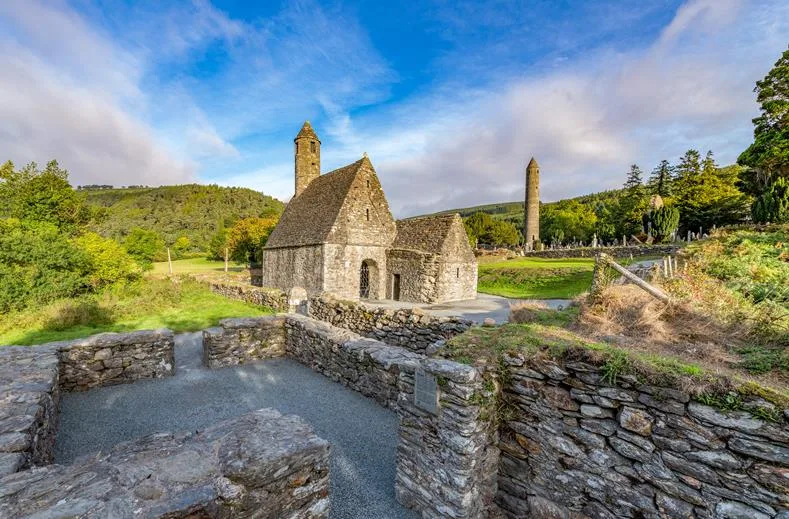
Walkers on WHI trails encounter Irish constantly without necessarily knowing it. The road signs in the Republic are bilingual — Irish first, English second. Place names are Irish in origin even where the English version has replaced daily use: Glendalough is Gleann Dá Loch, the valley of two lakes; Dingle is An Daingean, the fortress; Killarney is Cill Áirne, the church of the sloe tree.
Trail names in Irish
Understanding the Irish roots of trail names gives the landscape another dimension:
Slieve League (Sliabh Liag) — Mountain of Slabs
Croagh Patrick (Cruach Phádraig) — Patrick's Stack
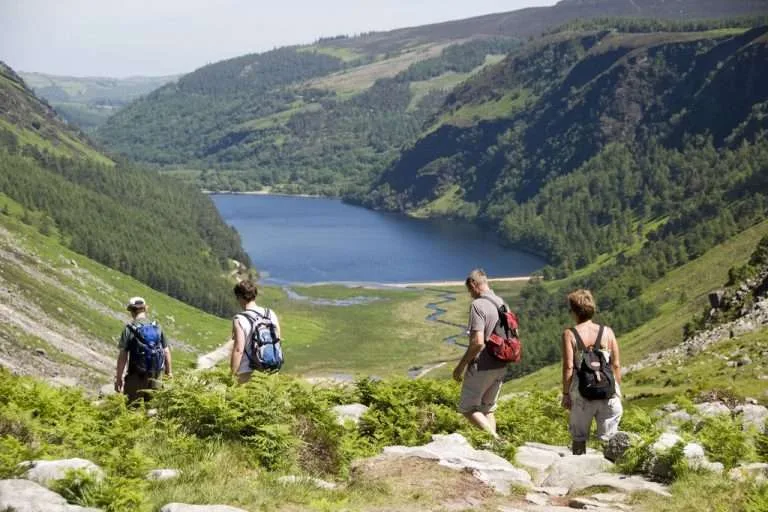
Glendalough (Gleann Dá Loch) — Valley of Two Lakes
Connemara (Conamara) — Inlets of the Sea
The Burren (An Bhoireann) — The Rocky Place
Cooley (An Chúlóg) — Corner/Recess
Useful Irish phrases for walkers
A few phrases earn immediate warmth from locals:
Dia dhuit (JEE-ah witch) — Hello (literally "God to you")
Go raibh maith agat (guh rev mah agut) — Thank you
Tá sé go hálainn (taw shay guh HAW-linn) — It's beautiful
Slán (slawn) — Goodbye
You don't need to be fluent. The attempt is what matters.
The GAA: Sport as Culture
The Gaelic Athletic Association is Ireland's largest sports organisation and one of the country's most significant cultural institutions. It runs Gaelic football, hurling, camogie, and handball at county, provincial, and national level — entirely amateur, entirely community-based, and deeply rooted in local identity.
Walking through rural Ireland, you will pass GAA pitches in almost every parish. The county colours — Kerry in gold and green, Wicklow in blue and yellow, Antrim in saffron and white — are visible on everything from jerseys in pub windows to painted walls. On summer Sundays when a county championship game is on, the roads to the local pitch carry an unmistakable current of community intent.
Hurling is particularly worth understanding. The oldest field sport in Europe, played with a curved wooden stick (camán) and a small leather ball (sliotar), hurling at its best is one of the fastest and most technically demanding team sports in the world. If a hurling match coincides with your evening in a pub anywhere in Munster (Cork, Kerry, Tipperary, Limerick), watch it. The whole room will explain what's happening.
Irish Pub Etiquette
The Irish pub is a cultural institution with its own unwritten rules. Most visitors navigate them instinctively after a single evening, but understanding the basics helps.
Rounds — groups buy drinks in rounds, and the obligation rotates. If someone buys you a drink, you buy the next round when glasses are getting empty. This is not optional; missing your round is a social solecism. If you don't want to drink the same amount as others in the group, drink more slowly, but participate in the round.
The bar — orders are placed at the bar, not with a server, in most traditional pubs. Walk up, make eye contact, wait. Don't wave or shout. The barman or barmaid will come to you.
Conversation — strangers talk to each other in Irish pubs. This is normal. A question about where you've come from or where you're going is an invitation, not an intrusion. The answer leads somewhere.
Children — pubs in Ireland vary on children. In rural areas and during daytime hours, children are generally welcome. After 9 PM in most pubs, the expectation shifts toward adult company.
For the full pub experience across WHI trails, our best pub walks guide covers the specific pubs worth finding on each route.
Irish Cultural Festivals on the Walking Calendar
Several festivals fall within the walking holiday season and are worth planning around.
Fleadh Cheoil — the world's largest Irish music festival, held in August in a different town each year. If it falls near a WHI trail, the cultural intensity is extraordinary: every pub, every pavement, every corner filled with musicians playing. The Fleadh has been held in Ennis, Sligo, Drogheda, and Tullamore among others — towns that walkers might pass through or base from.
Féile na Bealtaine (May festival) — a festival of Irish language arts and culture held in Dingle each May. For walkers on the Dingle Way, this festival adds a cultural layer to the town's already strong character.
Puck Fair, Killorglin — held in August on the Kerry Way, one of Ireland's oldest fairs. A wild mountain goat is crowned King Puck and installed on a platform above the town for three days. Livestock trading, music, and three days of general festivity. If your Kerry Way dates include mid-August, Killorglin is unmissable.
Culture Night (September) — national night of free cultural events across Ireland, usually the third Friday of September. Museums, galleries, traditional houses, and heritage sites open after hours. For walkers in their final days on any route, it provides an evening of cultural density in any town of any size.
Regional Cultural Character by Trail
Different WHI trails carry different cultural intensities.
Kerry and Dingle: The strongest Irish cultural concentration. Both areas are Gaeltacht or near-Gaeltacht; Irish is spoken as a daily language by a significant minority, trad music is vibrant, and the landscape carries mythological depth that pre-dates Christianity.
Wicklow: The eastern approach to Irish culture. More influenced by Dublin's cosmopolitan character, but the further south you walk, the more the rural Wicklow character reasserts itself. The Norman towns along the route — Carlow, Leighlinbridge — add a historical layer distinct from the Gaelic west.
Antrim and the Glens: A culture shaped by both Gaelic Irish and Ulster Scots traditions. The Glens of Antrim maintained an Irish-speaking community longer than most of Ulster; the landscape names are Irish, the trad music tradition is strong, and the area has a distinctive character that belongs to neither the pure Republican Irish tradition nor the Unionist tradition — it occupies its own cultural space.
Barrow Valley: Ireland's Ancient East. The Barrow passes through territory shaped by Cistercian monasticism, Viking settlement, Norman fortification, and the Famine — each visible in the landscape. The cultural character here is quieter, more inward, less musically prominent than the west, but historically richer.
Cliff's Note: Experiencing Irish Culture Visitors Guide Honestly
One thing I've noticed after years of walking in Ireland with guests: the cultural encounters that stay with people are rarely the scheduled ones. They're the session that starts spontaneously in a small pub on a Tuesday, the farmer who stops his tractor to talk for twenty minutes about the field you're crossing, the GAA match on television that turns an hour's stop into three hours.
Irish culture is participatory. It happens to you, not at you. The walking holiday format — small-scale, unhurried, staying in locally-run places — creates the conditions for genuine encounter that a tour bus or hotel cannot. That's not an accident of the itinerary. It's the point.
If you'd like to talk through which WHI trail puts you in the best position to experience Irish culture — musically, linguistically, historically — I'm happy to help.
Drop me a message through the contact page or WhatsApp me on +353 87 957 3856.
Browse our self-guided walking holidays in Ireland for the full range of routes.
— Cliff, Walking Holiday Ireland
You Might Also Enjoy
Celtic Culture and History
Frequently Asked Questions
Are the trails well-marked?
What is the most popular route?
What kind of boots should I wear?
What are the most essential items to pack for a walking holiday in Ireland?
Photo Gallery