Photography Guide: Best Spots on Irish Hiking Trails
Hiking Photography Ireland: Best Spots on Irish Trails
There's a quality to Irish light that professional photographers travel specifically to find. It changes constantly, arrives at strange angles, turns ordinary mountain sides into something luminous, and does this in a country where the landscape is already doing its best work.
Hiking photography Ireland spots reveal themselves to those who understand timing and light. Over years of walking with guests, I've noticed that the most memorable moments aren't always at the famous viewpoints. They're a particular shaft of light crossing a bog pool, mist lifting from a valley at 7 AM, the way the Atlantic catches colour in the final ten minutes before a western sunset. These moments are available to every walker. Capturing them well is mostly a matter of timing, position, and understanding how Irish light behaves.
This guide covers hiking photography Ireland spots by trail, how to work with Ireland's specific light, and what gear suits long-distance walking days.
Understanding Irish Light
Why Ireland's light is different
Ireland sits at the intersection of the Atlantic Ocean and the Gulf Stream at a latitude comparable to Moscow — but the oceanic climate moderates the temperature dramatically. The result is an atmosphere with exceptionally high moisture content, which does something specific to light: it diffuses, softens, and intensifies it simultaneously.
On clear days, Irish light has a clarity and sharpness that Mediterranean photographers find unusual. On overcast days, the same moisture creates what photographers call a diffuser — a giant natural softbox that eliminates harsh shadows and reveals colour with an intensity impossible under direct sun. The greens of Irish grassland, the purples of heather, the ochres of autumn bracken: these colours are typically undersaturated in direct sunlight and fully realised under soft cloud cover.
This is counterintuitive for photographers used to chasing clear skies. In Ireland, the most photogenic conditions are often what looks like disappointing weather.
The Golden Hour in Ireland
Golden hour — the period shortly after sunrise and before sunset when light is warm, low, and directional — works differently in Ireland than in most of Europe, and better.
Why: The high atmospheric moisture means the golden hour light in Ireland is warmer, more orange, and more dramatically coloured than the equivalent in drier climates. The Atlantic adds extra drama on western coastal routes — the sun drops toward water rather than land, creating reflection and colour simultaneously.
When: Golden hour timing varies considerably with season and latitude. At summer solstice (late June), sunrise in western Ireland is around 5:15 AM and sunset around 10 PM — nearly 17 hours of usable light with golden hour occurring at extraordinary inconvenience for anyone sleeping normally. In October, the same sunset is around 6:30 PM — much more manageable, and the autumn light quality is arguably the finest of the year.
Best months for golden hour photography on Irish trails: September and October. The angle of the sun is low enough to create dramatic directional light throughout much of the day, not just at the bookends. October morning light on the Wicklow Mountains is something photographers specifically travel for.
Mist and cloud
Irish mist — the low-lying atmospheric moisture that appears most mornings in valleys and above lakes — is one of the country's most photogenic atmospheric phenomena. Glendalough in morning mist is a completely different photograph from Glendalough in afternoon sun. The Wicklow plateau in soft cloud is different from the same terrain in clear weather.
Work with mist rather than waiting for it to clear. The clearing itself — shafts of light breaking through lifting cloud — is often the finest moment of all.
Best Hiking Photography Ireland Spots by Trail
Wicklow Way
The Wicklow Way delivers more consistently photogenic moments per kilometre than any other WHI trail, principally because its terrain is so varied — exposed moorland, ancient oak woodland, glacial lakes, mountain ridges, green valley floors — and because it runs close enough to Dublin that photographers make day trips specifically for it.
The upper bog sections between Lough Dan and Luggnagun are extraordinary in any light but particularly in mist and low autumn sun. The blanket bog, the scattered rocks, the occasional standing water — photographed against a complex sky, this is genuinely world-class landscape.
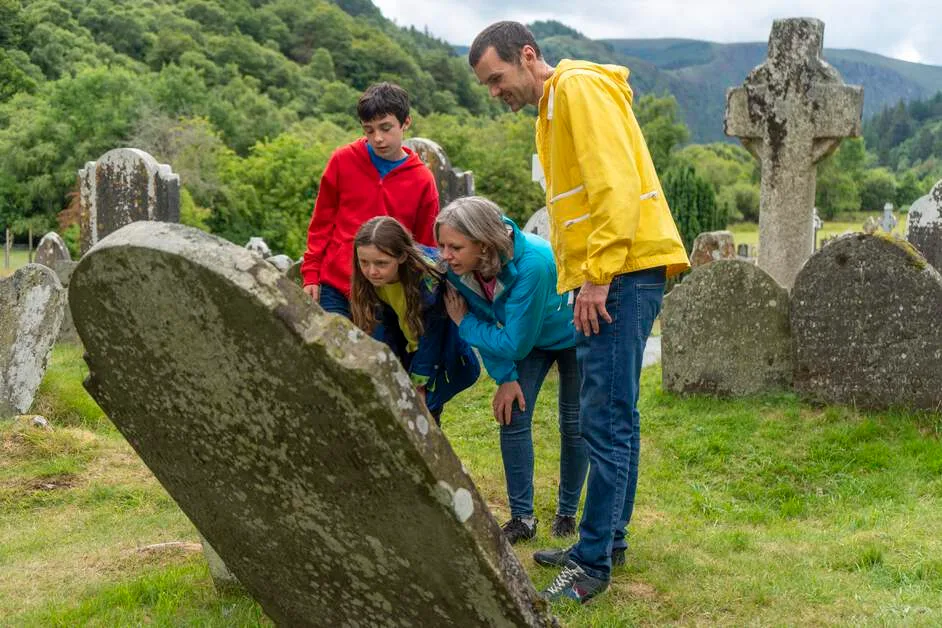
Glendalough deserves its own category. The upper lake from the western shore in morning mist, the round tower framed against the valley trees, the monastic ruins reflected in still water: these are iconic images that remain iconic for good reason. Arrive before 8 AM in spring or autumn to have the valley largely to yourself.
The ridge above Lugnaquilla on a clear morning gives a 360-degree view across Wicklow, Carlow, and Wexford with the Irish Sea visible to the east. The light on the glacial cwms below the summit at sunrise is exceptional.
Kerry Way and Ring of Kerry
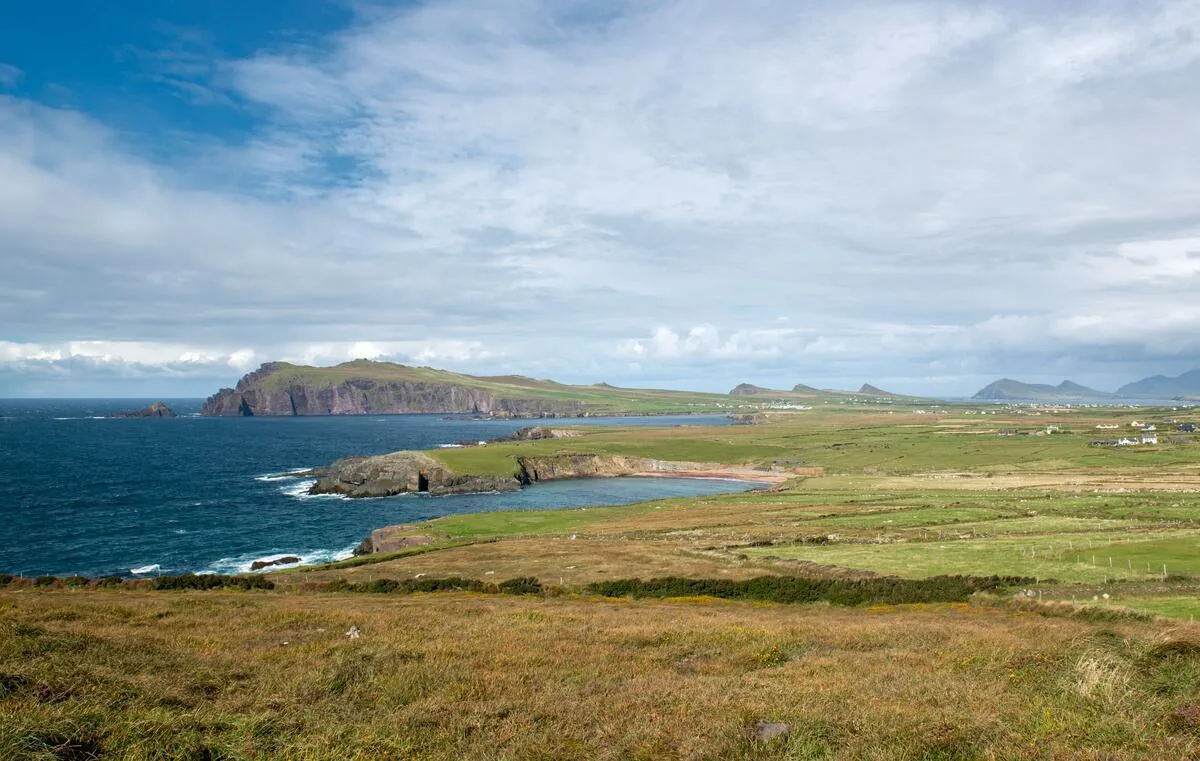
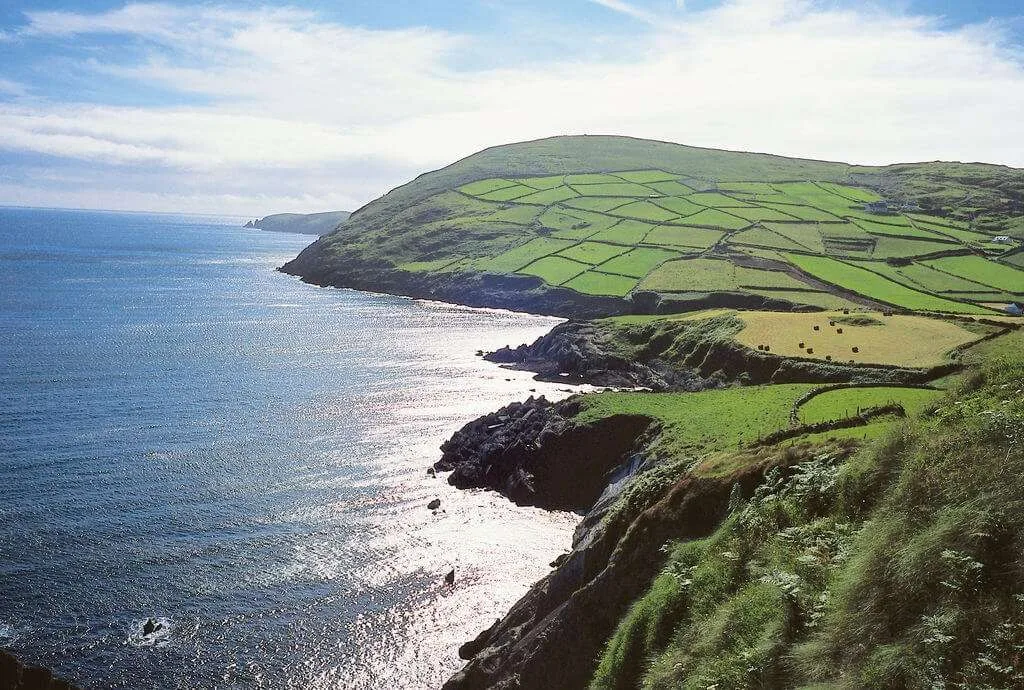
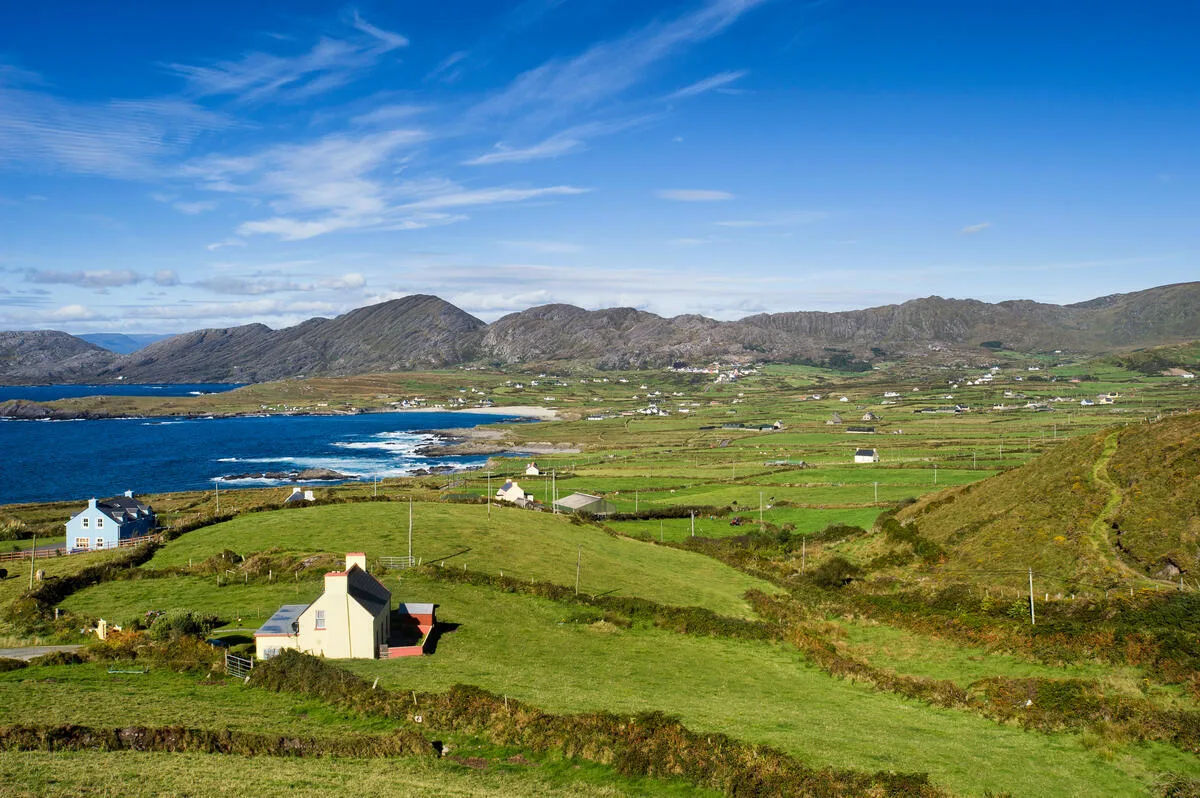
The Skellig Coast section of the Kerry Way — between Waterville and Caherdaniel — is the single finest photography stretch on any Irish trail. The path runs above Ballinskelligs Bay with direct views to Skellig Michael, 12 km offshore. The silhouette of the Skellig Islands against a western sunset is one of the most photographed images in Ireland; from the Kerry Way clifftops you have the same view elevated and without the tourist infrastructure.
The Gap of Dunloe at sunrise, before the jaunting cars begin, is a completely different and far superior photograph to the same view in afternoon. The glacial lakes catch the light sequentially from north to south as the sun rises.
Killarney National Park's ancient yew and oak woodland at Reenadinna provides dense green filtered light that has no equivalent elsewhere in Ireland — the oldest native woodland in the country, photographed in summer with the sun low through the canopy.
Our Ring of Kerry walks guide covers the route context.
Dingle Way
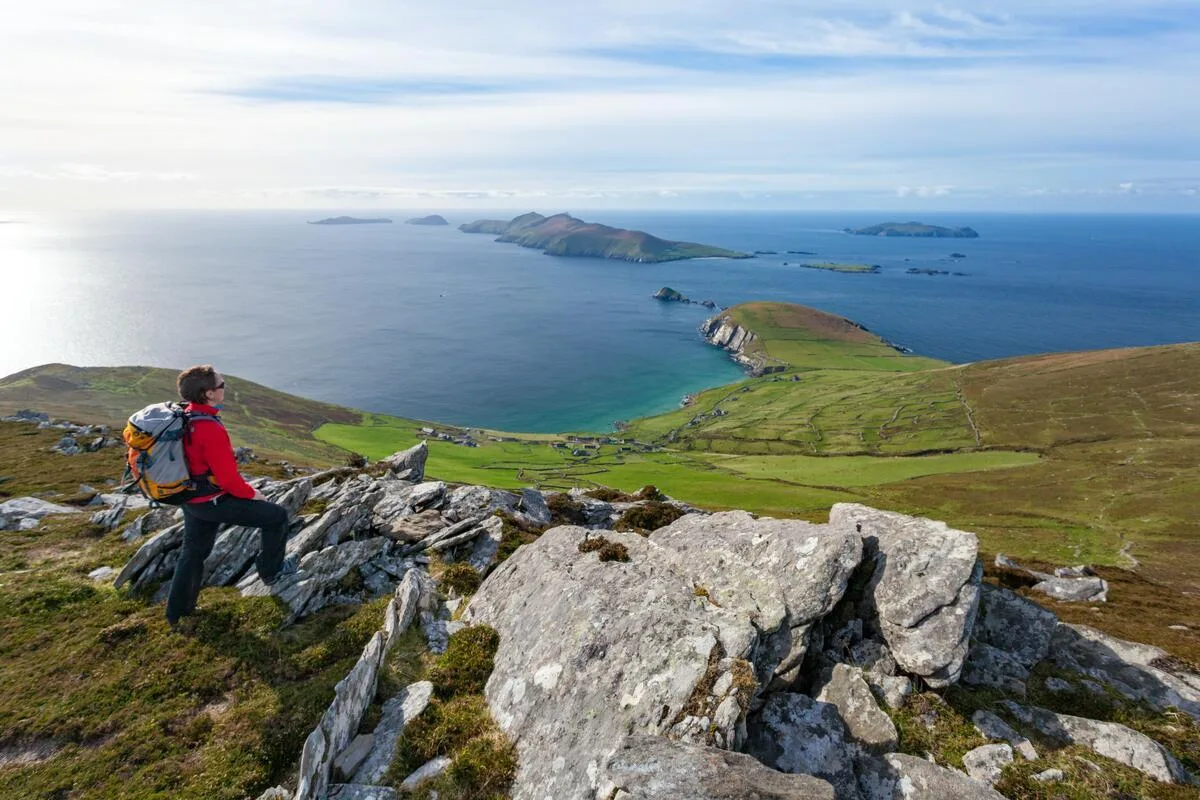
The Dingle Peninsula's photography character is determined by its geology: the Dingle Way crosses older and more dramatic formations than most of Kerry's other trails. The ancient beehive huts (clochán) near Fahan on the Slea Head road are among Ireland's most photographed archaeological features. The approach from the western coast walking section provides a different and less managed angle.
The Conor Pass — the highest road pass in Ireland — provides unobstructed views north to Tralee Bay and south to Dingle Bay simultaneously. At golden hour from the pass's upper car park (accessible by walking from the Dingle Way's higher sections), the two bays are lit sequentially as the sun moves.
Brandon Creek, where St Brendan is said to have launched his legendary Atlantic voyage, has a quality of dramatic intimacy — a narrow inlet between towering cliffs, usually in some state of Atlantic activity, relatively rarely photographed from the walking trail above.
Slieve League, Donegal
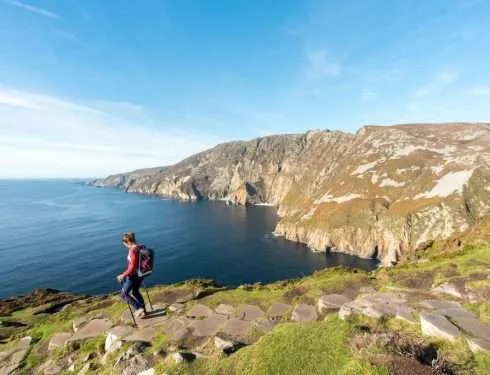
The Slieve League Cliffs are, in purely photographic terms, one of Ireland's most underused subjects. The Cliffs of Moher are photographed millions of times annually; Slieve League, at three times the height, is photographed by a fraction of that number.
The Bunglass viewpoint at sunset — the cliff face lit by western sun, the Atlantic below, the Benbulben silhouette visible to the south on clear evenings — is one of the finest coastal landscape photographs in Europe. Arrive 90 minutes before sunset and move along the clifftop to find the position where the full cliff face catches the light.
One Man's Pass in morning mist, with the exposure of the narrow ridge implied rather than shown by the cloud cover, is a different kind of photograph — more about atmosphere than drama.
Our Slieve League walk guide covers the access and route detail.
The Burren, County Clare
The Burren is the most complex photography subject in Ireland — the limestone pavement, the flowers growing in the rock cracks, the mediaeval stone walls, the ancient dolmens. It rewards close attention more than wide-angle landscape shooting.
Poulnabrone Dolmen at dawn — before the tour coaches — is one of Ireland's genuinely iconic photographic subjects: the Neolithic portal tomb silhouetted against an Atlantic sky, the limestone pavement in shadow below. Arrive 45 minutes before sunrise and work the light as it arrives.
The cliffline above the Burren Way at Ballinalacken, where the limestone meets the Atlantic, produces an extraordinary late afternoon photograph in autumn: the pale grey limestone, the dark sea, the warm directional light. Our Burren walking guide covers the route access.
Causeway Coast, Antrim
The Giant's Causeway needs different thinking for photographers. It's one of the most photographed places in the world and almost every conventional angle is exhausted. The opportunity is in timing and perspective: the hexagonal basalt columns from water level at low tide, in late September when the tourist numbers drop, at the moment a wave breaks and catches the last light.
Carrick-a-Rede Island from the mainland clifftop above the bridge, looking east toward Fair Head, on a clear morning, provides a photograph that almost no published image has captured — the island, the rope bridge, Fair Head, and Rathlin Island all in the same frame.
Our Antrim coast walk guide covers the full coastal trail.
Gear for Hiking Photographers
The fundamental tension
Hiking photographers face a specific equipment problem: camera gear is heavy and fragile; walking gear needs to be light and robust. Every extra kilogram of camera equipment is a kilometre of comfort lost by end of day.
The resolution is to be ruthless about what actually gets used on the trail. Most hiking photographers carry far more glass than they need because they can't decide what to leave behind. The practical reality of walking 20 km a day with a day pack is that a prime lens and a wide angle — or a single versatile zoom — is the right answer for almost every photographer.
The practical kit
Camera body: A modern mirrorless system gives the best weight-to-image-quality ratio. Full-frame is not necessary for landscape work at any distance.
Lens: A 24-70mm equivalent range covers almost everything on Irish trails — wide enough for coastal panoramas, long enough for isolating moorland details. A 16-35mm wide angle is worth adding for the Giant's Causeway and Slieve League cliff shots specifically.
Tripod: A compact travel tripod is the single most valuable addition for golden hour and mist photography. Without it, the specific light conditions that make Ireland's photographs distinctive are impossible to capture at low ISO. A carbon fibre travel tripod weighs under 1 kg and is manageable in a day pack.
Protection: Irish weather is Irish weather. A waterproof camera cover is essential, not optional. Rain will happen; the question is whether it happens to your camera or around it.
Filters: A polariser removes glare from wet surfaces and intensifies sky-to-cloud contrast. A 3-stop ND filter enables long exposures for moving water — Atlantic wave motion at Slieve League in daylight requires ND filtration.
Phone photography
Modern smartphone cameras are excellent landscape photography tools for sharing — not for large format printing, but for everything a walking holiday's social documentation requires. The practical advantage: no extra weight. The disadvantage: no control over depth of field in the genuine landscape sense, and battery drain if used heavily on a long day.
Keep the phone charged for navigation and WhatsApp first; photography second.
Seasonal Photography Guide for Irish Trails
Season | Light Quality | Best Routes | Special Conditions |
|---|---|---|---|
March–May | Sharp, clean, low angle | Wicklow, Burren | Spring flowers in Burren, clearing mist |
June–July | Long days, harsh midday | Kerry Way coast | Dawn and dusk shots; 17+ hrs daylight |
August–September | Warm, evening-focused | Slieve League, Dingle | Heather purple, Atlantic evening light |
October–November | Golden, dramatic all day | Wicklow, Antrim | Autumn colour, low sun angle, fewer crowds |
December–February | Rare clear days; frost | Glendalough | Snow on mountains when conditions align |
Plan Your Walking Holiday Around the Light
If photography is a significant part of why you're coming to Ireland, the choice of trail and timing matters. I'm happy to discuss which routes and months best match your photographic interests alongside your walking level.
Drop me a message through the contact page or WhatsApp me on +353 87 957 3856.
Browse our self-guided walking holidays for the full range of routes.
— Cliff, Walking Holiday Ireland
You Might Also Enjoy
Wildlife on Irish Hiking Trails
Best Time to Visit Ireland for Hiking
Frequently Asked Questions
Are the trails well-marked?
What kind of boots should I wear?
Are trekking poles recommended?
What size daypack should I carry while walking?
Photo Gallery