St Patrick's Way: Walking Ireland's Own Camino
St Patrick's Way: Ireland's Own Pilgrim Trail
Most people come to Ireland and never realise we have a Camino of our own. Not a borrowed idea, not a marketing line — a genuine, waymarked pilgrim trail with a passport to stamp and a certificate waiting at the end. St Patrick's Way runs 132 kilometres from Armagh to Downpatrick, linking the two places most bound up with Ireland's patron saint, and it threads together canal towpaths, granite mountains and a wild stretch of County Down coast along the way. If you've ever walked the Camino de Santiago and found yourself missing it, this is the trail we'd quietly point you towards.
We've spent a lot of time on this route, and we never tire of recommending it. Here's everything you need to know to start planning your own walk — the history, the stages, the famous Pilgrim Passport, and the honest truth about how hard it is.
Ireland's own Camino — and why it earns the name
The comparison to Spain isn't just clever branding. St Patrick's Way was created in 2015 and deliberately built around the same idea that makes the Camino so beloved: a meaningful journey on foot between two places that matter, with a record of your progress to carry home. In 2025 the trail celebrated its tenth anniversary, and it's quietly becoming one of the best-loved long walks in the north of Ireland.
What gives it real weight is the story underneath your boots. You begin near Armagh, Ireland's ancient ecclesiastical capital, where St Patrick founded his first stone church around 445 AD and where two cathedrals still bear his name today. You finish at Down Cathedral in Downpatrick, where a simple granite slab from the Mourne Mountains marks his traditional resting place. To walk Armagh to Downpatrick is to travel, in a handful of days, the arc of Patrick's life's work in this corner of Ireland.
The route, stage by stage
The official trail is divided into seven waymarked sections, marked with the familiar yellow Camino-style arrows. Most walkers take somewhere between six and nine days, depending on pace. Here's how the journey unfolds.
From Armagh through the orchard country
You set off at the Navan Centre on the edge of Armagh — Emain Macha, the 3,000-year-old former capital of Ulster — before a tour of the city itself. The early days roll gently through County Armagh's drumlin country: hedgerow lanes, quiet farmland, the green of the Orchard County. It's an easy, settling-in kind of walking that lets the journey build.
Along Ireland's oldest canal
The Scarva-to-Newry stage is one of our favourites, and the most meditative on the whole trail. You follow the towpath of the Newry Canal — the oldest summit-level canal in Britain or Ireland, opened back in 1742 — through a flat green corridor of water, woodland and birdsong. After a long day it's the kind of walking that empties your head in the best way.
Into the Mourne Mountains
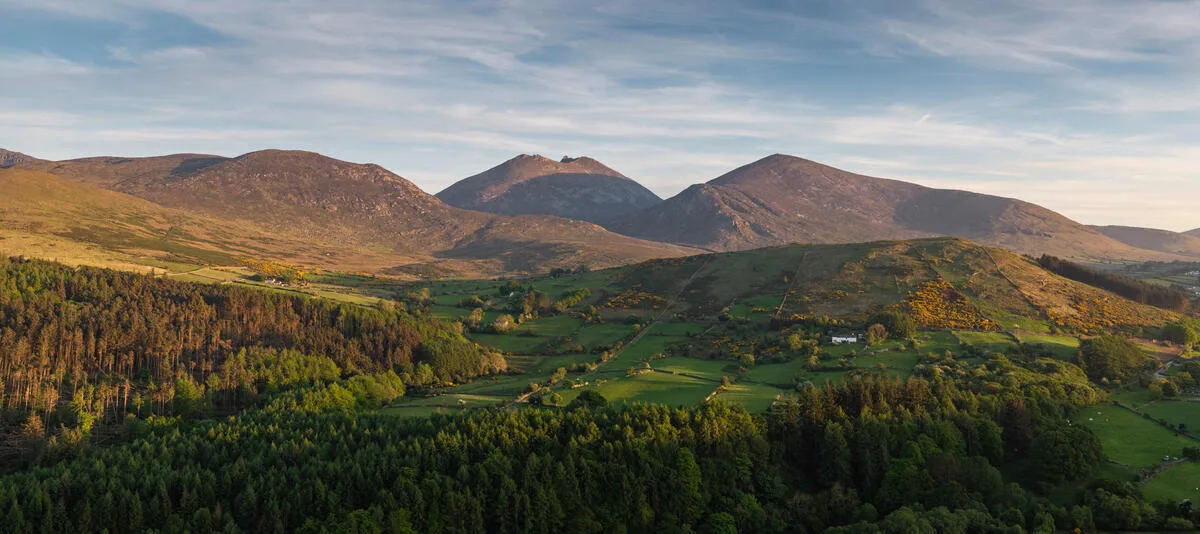
Then everything changes. The crossing from Rostrevor to Newcastle climbs into the Mourne Mountains, and this is the day walkers remember most. Granite peaks, heather moorland and forest trails open up beneath Slieve Donard, Northern Ireland's highest mountain at 850 metres, with views stretching across Carlingford Lough to the Irish Sea. You descend through Tollymore Forest Park into Newcastle, a classic seaside town with the mountains rising right at its back door.
The quiet coast to Downpatrick
The final stretch is a gentle reward. You walk past the ancient sand dunes of Murlough — Ireland's first nature reserve — by the Norman ruins of Dundrum Castle, across the vast sweep of Tyrella Beach, and on through quiet lanes to Downpatrick. The journey ends on Cathedral Hill, with Saul Church (said to be the site of Ireland's very first church) and the old Struell Wells close by.
The Pilgrim Passport — the bit that makes it a pilgrimage
This is the detail that turns a long walk into something you'll talk about for years. Pick up a free Pilgrim Passport at any local Visitor Information Centre — the Navan Centre in Armagh is the natural place to start — and collect a stamp at each of the ten designated points along the way. Carry your stamped passport to the Saint Patrick Centre in Downpatrick at journey's end, and you'll receive a Certificate of Achievement.
It's the trail's own version of the Camino's Compostela, and there's something genuinely lovely about it. The stamps become a little diary of your days. The certificate is a keepsake with real meaning behind it. And the finish — handing over a full passport at the saint's own resting place — gives the walk a sense of completion that very few trails anywhere can match.
How hard is the walking, really?
We always give people the honest version. St Patrick's Way is a moderate trail with one genuinely demanding day. Most of the route is comfortable walking on canal towpath, country lanes and forest tracks. The exception is the Mourne crossing from Rostrevor to Newcastle — around 38km over exposed mountain terrain, with real ascent. That's a proper mountain day, and it asks for decent fitness, good waterproof boots, layers and an eye on the forecast.
The good news is that you don't have to take it on all at once. We offer the trail in three lengths to suit how you like to walk:
- A 7-day walk for those who want the classic route at a steady pace.
- An 8-day walk that splits the big Mourne day into two gentler stages via Kilkeel.
- A 9-day Entire Route that walks just one stage per day from start to finish — the most relaxed way to do it, and a favourite with walkers who'd rather savour the journey than rush it.
Whichever you choose, we take care of the logistics — handpicked B&Bs and guesthouses, full Irish breakfasts, and luggage transferred ahead each day so you walk with nothing but a daypack.
When to walk St Patrick's Way
The walking season runs from April to October, and May, June and September are the sweet spots. Late spring brings long days, wildflowers and quiet trails; September offers that soft golden autumn light and fewer visitors at the heritage sites. The Mournes can be cool and misty even in high summer, so pack layers for the mountain stage whenever you come. July and August are the warmest months but can hold more cloud on the peaks.
A few practical things to know
The whole trail sits within Northern Ireland, so you'll be spending British Pounds (£), though some businesses near the border happily take Euro too. Since 2025, most non-UK and non-Irish visitors need a UK Electronic Travel Authorisation (ETA) — it costs around £16 and you apply online before you travel. Irish passport holders are exempt. Armagh is about an hour from Belfast and two from Dublin, with good bus links from both, and Downpatrick is a half-hour from Belfast for the journey home.
For more on the trail's heritage, the folks at Visit Armagh and the Saint Patrick Centre are well worth a read before you set off.
Ready to walk Ireland's Camino?
There's a particular kind of satisfaction in this walk — the history under your feet, the Mournes on the horizon, and a stamped passport growing fuller with every day. If you've been looking for a pilgrim trail closer to home, or simply a beautiful long walk with a story to tell, St Patrick's Way is hard to beat.
Have a look at our 7-day and 8-day Saint Patrick's Way walking holidays to see what a typical day looks like — and if you've any questions at all about the route, the timing or which length suits you best, get in touch. We'd love to help you plan it.
Photo Gallery